
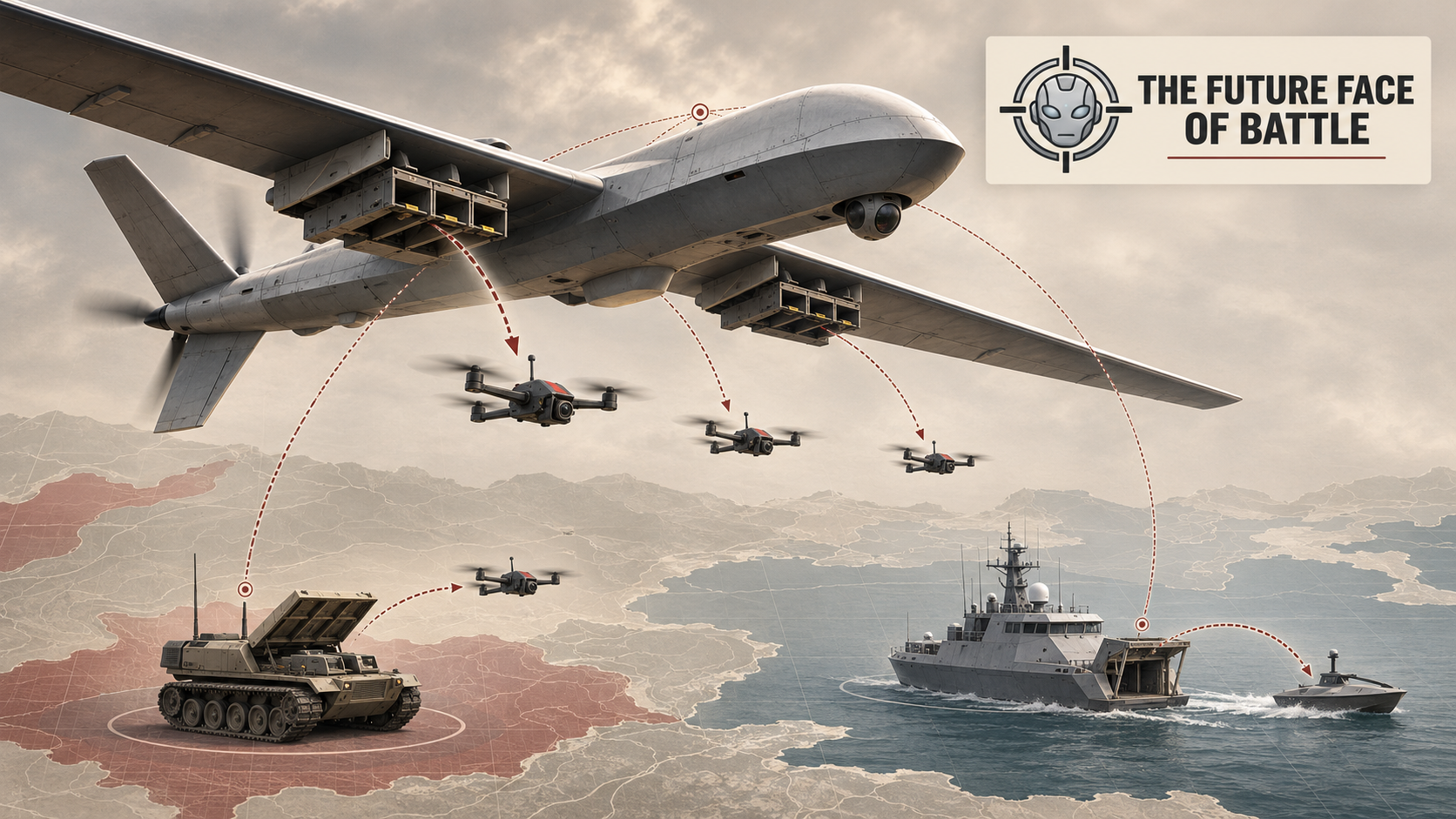
On November 4, Türkiye’s Baykar published footage of a Bayraktar TB2 carrying 16 Skydagger FPV attack drones, eight beneath each wing. During the test, the TB2 released two of the smaller drones, which were controlled by ground operators through the aircraft’s data link and struck their designated targets.
The demonstration did not show an autonomous swarm. It showed something more immediately practical: an established medium-altitude unmanned aircraft being converted into an airborne base for smaller and cheaper weapons.
The TB2 transported the FPV drones to the mission area, released them and served as a communications relay between the drones and their operators. This combination addresses several of the most persistent limitations of small unmanned systems: short range, limited battery life, dependence on line-of-sight communications and the vulnerability of forward launch teams.
It is also the latest example of the military “drone mothership”, a concept now appearing in the air, at sea and on land.
Separating transport from terminal effect
Small drones are inexpensive and difficult to detect, but they cannot carry much fuel, sensing equipment or communications hardware. A larger platform can transport them over the least useful portion of the journey, allowing them to preserve their batteries for searching, waiting and attacking.
Launching from altitude offers another advantage. An FPV drone released from a TB2 does not need to climb from a ground position or navigate around terrain before beginning its mission. The carrier’s altitude also provides a better communications line of sight, allowing it to relay signals over hills, buildings and other obstacles that would block a direct radio link.
The same logic was demonstrated in July 2025, when General Atomics and AeroVironment launched a Switchblade 600 loitering munition from an MQ-9A. According to the companies, the combination increased the effective reach of the Switchblade while allowing the MQ-9 to remain farther from hostile air defences.
General Atomics has pursued the concept further with Sparrowhawk, a small aircraft designed to deploy from an MQ-9 for intelligence, electronic warfare and jamming missions. The more ambitious objective is to recover Sparrowhawk in flight, permitting repeated use.
DARPA demonstrated the feasibility of airborne recovery through its Gremlins programme. In 2021, an X-61 Gremlin unmanned aircraft was recovered by a C-130 transport aircraft, refurbished and flown again within 24 working hours. The idea was to combine the reach of a transport aircraft with reusable, limited-life drones that could enter areas too dangerous for the carrier.
The concept is not limited to aircraft
At sea, a mothership can store, maintain, launch and recover several types of uncrewed system. The Royal Navy is adapting RFA Lyme Bay to serve as a minehunting mothership, supporting unmanned surface vessels and underwater vehicles while keeping sailors outside suspected minefields.
During BALTOPS 23, the US Navy tested an unmanned surface vessel carrying and launching an underwater vehicle. The surface vessel transported the UUV into a hazardous area, replacing the crewed boat that would normally perform the task. This created a layered structure: a crewed command ship remained at a safe distance, the USV entered the contested area, and the UUV conducted the underwater search.
Ukraine has applied the same principle on land. In 2026, Ratel Robotics released footage showing the combat use of a Ratel H ground robot as a mobile launch platform for up to four fibre-optic FPV drones. The ground vehicle could move the drones towards the front without exposing a launch team. Once positioned, the drones were launched to conduct individual attack missions.
This configuration is especially relevant in environments saturated with surveillance drones. A stationary launch team, antennas and vehicles can be detected within minutes. A remotely operated ground carrier can instead be pre-positioned, concealed or sacrificed without exposing personnel.
A mothership is not necessarily a swarm
The terms are frequently confused, but they describe different aspects of an unmanned force.
A mothership describes how smaller systems are transported, launched, supported or recovered. A swarm describes how multiple systems behave after deployment.
If 16 drones are released and each is controlled by a separate operator, they constitute a group of drones, not necessarily a swarm. According to the US Government Accountability Office, swarm systems use algorithms, local sensing and communications to coordinate multiple drones in pursuit of a shared objective with limited human attention.
A genuine swarm may divide a search area, exchange target information, reallocate tasks when one drone is lost and change formation in response to threats. It does not require a mothership and could be launched from several dispersed locations. Conversely, a mothership can carry drones that have no ability to cooperate with one another.
The two concepts become especially significant when combined. A carrier could bring dozens of autonomous or semi-autonomous systems to the edge of a defended area, provide the initial mission plan and release them. The drones could then distribute tasks among themselves and continue operating when their connection to the carrier becomes intermittent.
The operational value, and the risk
The mothership architecture separates the expensive capabilities from the expendable ones. Long-range communications, satellite connectivity, powerful sensors, AI processing and mission management remain on the larger platform. The smaller systems carry only what they need for the final portion of the mission.
This can reduce costs, accelerate adaptation and allow commanders to concentrate large numbers of systems at a specific time and place. It can also create new combinations of effects. One group of drones could search for air defences, another could jam communications, and a third could attack the targets exposed by the first two.
But the carrier is also a potential single point of failure. Destroying or jamming it may disrupt communications with every system it supports. Its larger radar, thermal or electromagnetic signature can reveal the operation, while limited bandwidth may become a bottleneck when numerous drones transmit video simultaneously.
Future designs will therefore probably rely on several distributed carriers rather than one central mothership. Control may pass between aircraft, ground vehicles and ships, while onboard AI enables the smaller systems to continue their assigned missions when communications are degraded.
The TB2 test is important not because it demonstrated a fully autonomous swarm. It did not. Its significance is that it turned a familiar reconnaissance and strike drone into an airborne forward base for a new class of inexpensive weapons.
The carrier provides reach, communications and computing. The smaller drones provide numbers, precision and the ability to enter areas where the carrier cannot safely operate. Together, they represent a different way of assembling combat power, one in which the most important platform may no longer be the weapon that reaches the target, but the system that brings many other weapons within reach.
Explore stories by subject ↗