
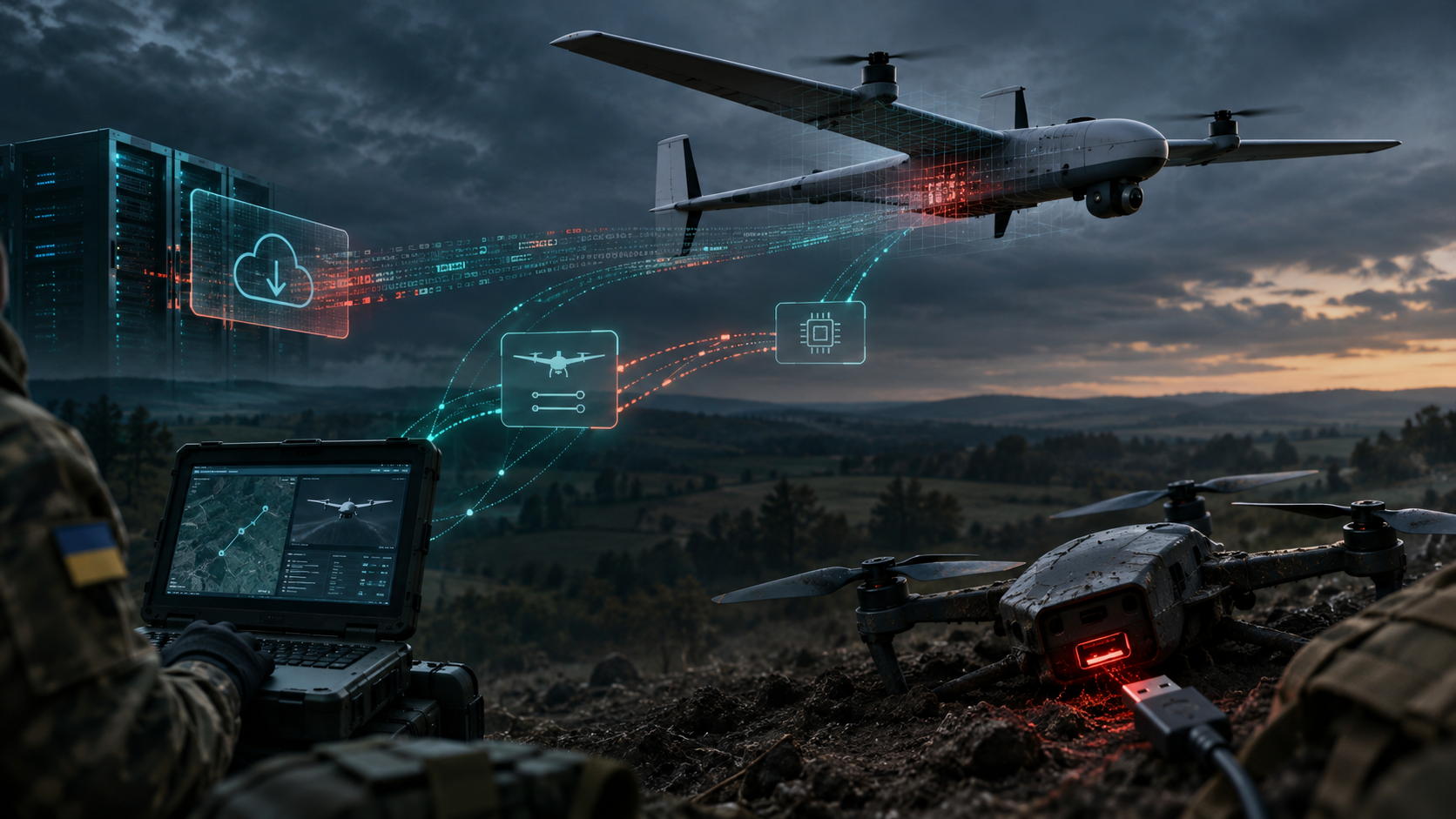
A cyberattack discovered in late October 2026 at German drone manufacturer Quantum Systems temporarily grounded the company's aircraft operated by the German military. According to reporting by the Financial Times and Der Spiegel, attackers managed to introduce a malicious file into the update-distribution infrastructure for QBase, software used for mission planning and ground control of drones including the Vector reconnaissance platform, which is operated by German and Ukrainian forces.
The malicious file reportedly reached servers belonging to the German military and other customers, but there was no reported compromise of the aircraft's flight systems. Nevertheless, the Bundeswehr suspended operations as a precaution, and the company missed a planned military exercise. On November 13, Quantum Systems said operations in Germany had resumed and its systems were functioning normally worldwide. The attackers have not been publicly identified.
The incident illustrates a fundamental shift in the threats facing unmanned systems. A drone is not merely an aircraft equipped with sensors, propulsion, and a camera. It belongs to a much larger digital architecture of ground-control stations, mission-planning applications, communications links, update servers, intelligence-processing systems, and components supplied by third parties. Each can become an entry point for an adversary.
In the Quantum Systems case, an attacker did not need to shoot down a drone or seize control of one in flight to affect military operations. Doubts about software integrity alone were sufficient to interrupt operational capability. This is the central risk of a software supply-chain attack against a software-dependent weapon system.
UKRAINIAN DRONES AS TROJAN HORSES
In April 2025, reports described a very different Ukrainian approach: planting malware inside drones that might be captured by Russian forces.
According to reporting by Forbes, cited by DroneLife and based partly on a Russian video circulated online, Russian personnel allegedly encountered Ukrainian drones containing malicious code intended to affect anyone attempting to inspect, reprogram, or reuse them.
The accounts described several possible mechanisms: damage or disruption through USB connections when a drone is attached to a computer, blocking firmware replacement, and even exploiting a captured drone to expose the location of its new operator.
Unlike the Quantum Systems incident, in which attackers targeted the manufacturer's update infrastructure, this approach allegedly uses the drone itself as a vehicle for delivering malicious code into an adversary's systems. Rather than simply trying to prevent equipment from falling into enemy hands, the tactic attempts to make the enemy's effort to exploit captured equipment a liability.
These claims require caution. Public information rests heavily on video footage and Russian accounts rather than a complete, independently verified technical analysis. Not every alleged mechanism has been demonstrated publicly.
The broader concept is not new. Malware delivered through physical devices has existed for decades. What is different is its proposed integration into military equipment that routinely falls into enemy hands. In a war where thousands of drones are destroyed, recovered, or captured, such equipment presents an additional attack surface.
MANUFACTURERS ARE TARGETS TOO
The threat is not confined to drones on the battlefield. In July 2026, Australian flight-control technology company CubePilot, a vocal supporter of Ukraine, was reportedly targeted in an attack involving the redirection of DNS traffic, disrupting its operations.
Compromising DNS infrastructure can allow an attacker to redirect users and services to servers outside the original provider's control. Under some circumstances, that can facilitate credential theft, malicious downloads, or interference with software updates. In the CubePilot case, there was no public confirmation that malicious updates had been distributed to customers. Nevertheless, the incident highlighted the vulnerability of the digital infrastructure supporting unmanned systems.
The common denominator is the growing dependence of military platforms on software and external digital services. As manufacturers incorporate commercial components, open-source code, and cloud infrastructure, the security of more organizations becomes relevant to the reliability of the finished system.
FROM CYBER INTRUSION TO BATTLEFIELD EFFECTS
Cyber threats to unmanned systems can be divided into several layers, each capable of producing a different operational outcome.
A supply-chain attack can affect numerous systems through a shared provider. In the Quantum Systems case, the apparent compromise of an update mechanism undermined confidence in system integrity and prompted a temporary operational halt.
An attack on ground-control stations may expose flight plans, operator locations, intelligence, and mission data. In more serious cases, it could enable interference with commands sent to an aircraft.
Attacks on communications may involve disruption, impersonation, or attempts to inject commands. It is important to distinguish electronic warfare, such as GPS and radio jamming, from cyberattacks that exploit software or protocol vulnerabilities. The two can also be combined.
An attack against onboard software may target flight-controller firmware, navigation systems, or mission computers. Unlike a temporary communications disruption, a successful compromise of these components could persist even when the aircraft is operating autonomously without a continuous link to its operator.
AUTONOMY AND AI EXPAND THE CHALLENGE
The increasing use of artificial intelligence in unmanned systems adds another layer of complexity. Modern drones can perform some navigation, object recognition, and data-processing tasks on onboard computers, reducing their dependence on ground-control stations.
These capabilities improve resilience against communications disruption, but also create new attack surfaces. Manipulation of processing software, sensor data, or models used in decision-making could cause an autonomous system to act on false information.
For example, an adversary might attempt to deceive a computer-vision system by manipulating its inputs, or compromise an update to software supporting autonomous functions. These are recognized technological risks, but there is no evidence that such methods were used in the Quantum Systems incident.
As more missions are performed by autonomous systems, security must protect not only communications links but also the integrity of the data, firmware, and software on which those systems base their decisions.
CYBERSECURITY AS OPERATIONAL READINESS
These incidents and allegations show three distinct ways cyber operations intersect with unmanned warfare: a drone may carry malicious software, a manufacturer may become an entry point into military systems, and a ground-control network may itself be a target.
For armed forces and manufacturers, cybersecurity cannot end with development or procurement. It must cover the entire lifecycle of a system, from supplier verification and secure update distribution to software validation and the ability to operate when an external service is compromised.
The German incident also demonstrates the importance of recovery. Even without a reported takeover of an aircraft, the military had to suspend operations while assessing the risk. During active combat, a comparable interruption could affect intelligence collection, mission planning, and weapon availability.
As unmanned systems become increasingly central to operations on land, in the air, and at sea, the distinction between cybersecurity and the protection of operational capability is narrowing. Control over a drone is determined not only by who holds the controller or commands the radio link, but also by who controls the software, updates, and data on which the system depends
Explore stories by subject ↗