
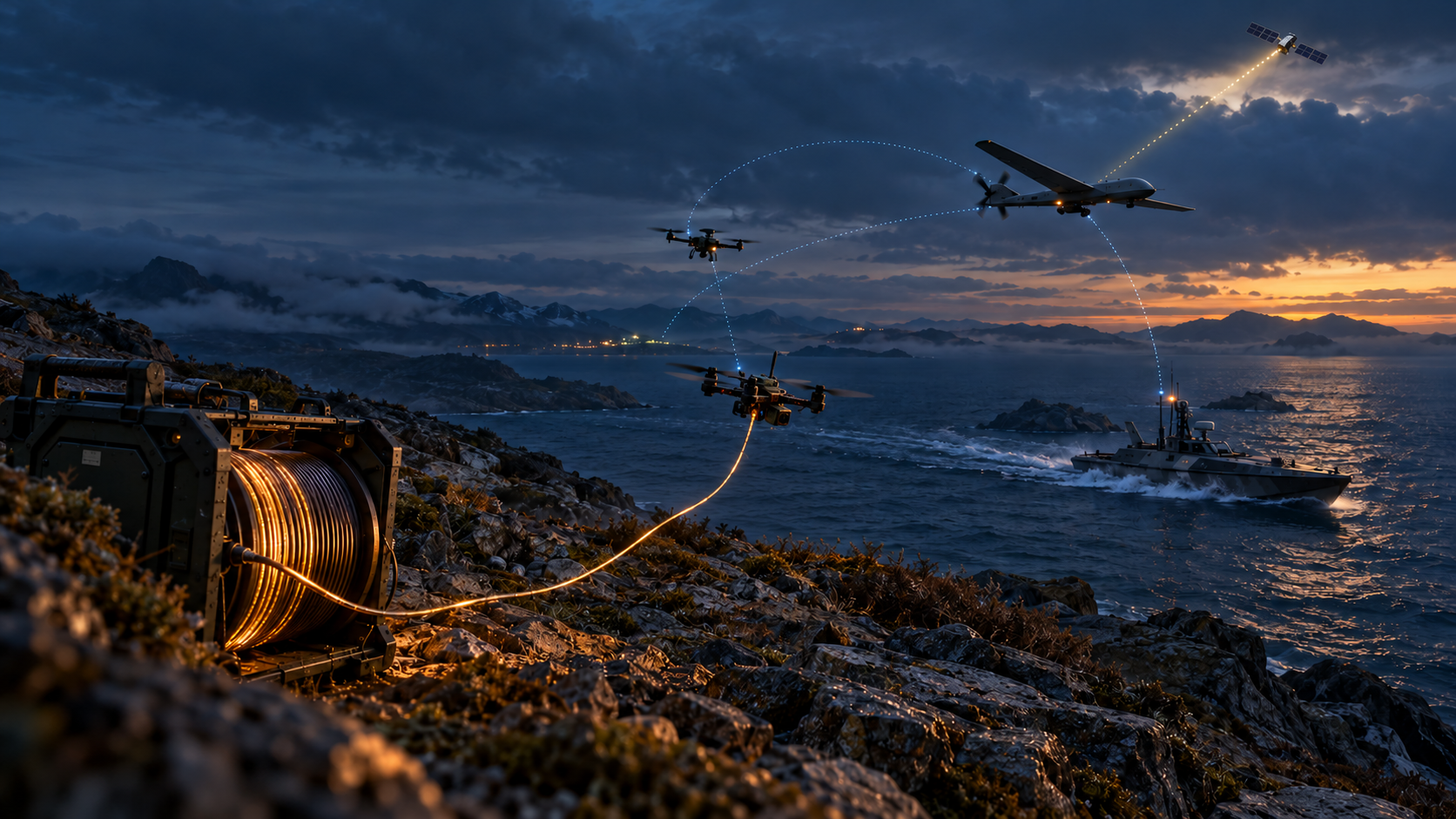
The most visible component of an unmanned system is the vehicle itself. Yet the part that often determines whether it can complete a mission is less visible: the chain of radios, antennas, satellites, relays, modems, encryption systems and software that carries commands in one direction and sensor data in the other.
This chain is the nervous system of unmanned warfare. It allows an operator to steer an FPV drone, a headquarters to redirect an autonomous aircraft, a surface vessel to transmit radar tracks, or an underwater vehicle to report its position. It also creates a vulnerability. If the link is detected, jammed, spoofed, throttled or physically cut, a remotely controlled platform can become ineffective even when the vehicle itself remains intact.
No single communications method solves the problem. Satellite links provide reach but depend on external infrastructure. Tactical radio is flexible but constrained by terrain, spectrum congestion and line of sight. Fiber-optic control is highly resistant to electronic warfare but limits maneuver and leaves a physical trail. Underwater vehicles face an even harsher environment in which radio waves penetrate poorly and acoustic links offer only modest bandwidth. The emerging answer is not a perfect link, but a layered architecture that combines several links with increasing onboard autonomy.
Satellite communications: reach at a priceSatellite communications allow unmanned aircraft and vessels to operate far beyond the radio horizon. Geostationary satellites offer broad coverage, while proliferated low Earth orbit constellations can provide lower latency and higher capacity. The U.S. Space Force now describes its future satellite architecture as a diversified network spanning providers, orbits and frequencies, rather than a small collection of high-value satellites. Its stated goal is to create a resilient, low-latency transport layer that can continue operating in a contested environment.
For unmanned systems, this architecture can support long-range command, video transmission, mission updates and coordination between dispersed forces. Ukraine has demonstrated the operational value of commercial satellite networks, particularly for connecting command posts and supporting long-range unmanned missions. It has also demonstrated the risk of dependence on a commercial provider. In October 2026, Ukrainian officials said that changes to Starlink services disrupted some military drone and logistics operations, including brief connection losses at high speed. The episode was a reminder that service rules, commercial decisions and political pressure can affect a military capability even when the adversary has not successfully jammed it.
Satellite links also face physical and technical constraints. Antennas require access to the sky. Terminals emit signals that may be detected. High data demand can produce congestion, and even low Earth orbit networks introduce latency that matters for precise piloting. Adversaries can jam uplinks and downlinks, interfere with navigation signals, attack ground stations or target satellites. Protected military waveforms, directional antennas, frequency diversity and multi-orbit terminals can reduce these risks, but they increase cost and complexity.
Radio: flexible, local and contestedRadio remains the primary means of controlling most tactical drones. It is portable, relatively inexpensive and capable of carrying command signals, telemetry and video. It is also governed by basic physics. Higher frequencies can carry more data but are more easily blocked by terrain and buildings. Lower frequencies travel farther and penetrate obstacles more effectively, but usually provide less bandwidth and require larger antennas.
The modern response is a network rather than a single point-to-point link. Self-forming and self-healing mesh networks allow vehicles, ground stations and airborne relays to pass data through multiple paths. The U.S. Army describes mesh backhaul radios that can be mounted on vehicles, command posts, Gray Eagle aircraft and elevated antennas. If one node disappears, the network can route traffic through another.
Ukraine has applied the same principle at the tactical edge. Dedicated airborne repeaters climb above terrain and electronic clutter to extend command and video links for FPV drones. A relay drone can remain behind the strike vehicle, maintaining line of sight with both the operator and the aircraft. More advanced systems can automatically accompany another drone and return after the mission. The benefit is greater reach and a more stable connection. The cost is an additional platform, another radio signature and another target for electronic warfare.
Resilience therefore depends on more than transmitter power. Directional antennas concentrate energy toward the intended receiver and reduce exposure elsewhere. Frequency hopping makes it harder for a jammer to remain on the correct channel. Adaptive waveforms can change modulation and data rate as conditions deteriorate. Encryption protects content, while authentication helps prevent an adversary from injecting false commands. A well-designed force also uses a PACE plan: primary, alternate, contingency and emergency communications, with operators trained to move between them.
Fiber optics: trading mobility for certaintyThe rapid spread of fiber-optic FPV drones in Ukraine represents a different solution. Instead of transmitting control and video over radio, the drone unreels a thin cable as it flies. Because the signal remains inside the fiber, conventional radio-frequency jamming cannot break the link, and the drone does not depend on satellite navigation for control.
Ukraine has authorized fiber-controlled attack drones with ranges exceeding 30 kilometers and has treated them as a critical battlefield capability. According to Ukraine's Defence Procurement Agency, 374,000 fiber-optic drones were contracted in 2025, followed by rapid deliveries in 2026. The scale matters because fiber-optic control is no longer a niche response to jamming. It has become an industrial category of weapon.
The advantages are substantial: stable high-quality video, low latency, resistance to radio jamming and a reduced electromagnetic signature. The limitations are equally real. The spool adds weight and drag. The cable can snag on trees, buildings, power lines or wreckage. Sharp turns can damage it, while the route may reveal the direction of launch. Longer range requires more fiber and therefore a heavier spool. The solution is especially effective for deliberate attack routes through intense electronic warfare, but it is not a universal replacement for radio.
Tethered drones are related but distinct. A tethered surveillance drone normally remains attached to a ground station that supplies power and carries data, allowing it to stay aloft for long periods. A fiber-optic FPV drone, by contrast, carries its cable spool and leaves the cable behind as it advances. One is a persistent mast in the sky; the other is a moving weapon that exchanges unrestricted maneuver for an exceptionally reliable control channel.
Beneath the surfaceUnderwater communications impose the hardest limits. Radio-frequency signals attenuate rapidly in seawater, especially at frequencies capable of carrying useful amounts of data. Very low frequency signals can reach submerged submarines, but require enormous transmitters and support only limited data rates. Optical links can transmit rapidly over short distances in clear water, but turbidity and alignment restrict their use.
Most autonomous underwater vehicles therefore rely on acoustic modems. Sound travels through water far better than radio, allowing operators to receive position, health and limited sensor information or send mission updates. The tradeoff is low bandwidth, significant latency, variable propagation and vulnerability to environmental noise. The U.S. Navy's HUGIN 54 search vehicle, for example, can operate autonomously for up to 50 hours while using acoustic links for status monitoring and selected payload data.
One method of extending the chain is to place an unmanned surface vessel above the underwater vehicle. The submerged system communicates acoustically with the surface relay, which then uses radio or satellite communications to reach a distant command center. The U.S. Navy has demonstrated this architecture with a REMUS 100 underwater vehicle and a surface craft that relayed commands and sensor data by satellite. The arrangement connects two very different networks, but it also creates a detectable surface node that may become the weak point of the system.
When the link is degradedElectronic warfare rarely produces a simple state of connected or disconnected. More often, it increases packet loss, reduces video quality, adds delay, forces a lower data rate or creates intermittent gaps. These effects are dangerous because an operator may still receive information, but too late to make a correct decision.
Designers can respond by prioritizing traffic. Flight-control commands and vehicle health data require little bandwidth and should take precedence over high-resolution video. Compression can reduce the video load, while edge processing can transmit detections or short clips instead of a continuous raw feed. Store-and-forward methods allow a platform to collect data during a communications blackout and transmit it later. Delay-tolerant networking is particularly useful for maritime and long-range missions where continuous connectivity cannot be assumed.
The larger architectural response is redundancy. A vehicle may carry several radios, switch between satellite and terrestrial networks, use an airborne relay, or fall back to a low-bandwidth emergency channel. The communications system must also be integrated with navigation. Losing GPS is not the same as losing the command link, but the failures can reinforce each other. A drone that loses satellite navigation may still be remotely piloted if its video and control link remains intact. A drone that loses communications may still continue a preplanned route if its inertial, terrain-relative or visual navigation remains reliable.
AI and the shrinking dependence on the operatorThe long-term answer to communications denial is greater local decision-making. If a system requires a human operator to approve every movement and interpret every sensor frame, it remains dependent on a continuous, high-bandwidth connection. If onboard software can stabilize the vehicle, navigate around obstacles, recognize relevant objects, coordinate with nearby platforms and preserve mission intent, the network can carry higher-level instructions rather than constant control inputs.
DARPA's Collaborative Operations in Denied Environment program demonstrated aircraft that could share information, allocate mission objectives and adapt to threats with minimal communication. When links were degraded, the vehicles retained the commander's mission intent and continued operating without live direction. DARPA's later REMA program pursues a related goal by adding mission-specific autonomy to existing commercial and military drones, specifically to reduce the effectiveness of electronic countermeasures that sever operator links.
This does not make communications irrelevant. Autonomy changes what must cross the network. Instead of transmitting every control input and every video frame, a human may send an objective, geographic boundary, rule set or abort condition. The vehicle can return concise status reports, detected objects and requests for authorization. A group of unmanned systems may coordinate locally, selecting routes or distributing search areas without routing every interaction through headquarters.
AI can also make the communications layer more adaptive. Software can predict link degradation, select a different radio, alter the waveform, reduce the data rate or choose a new relay. Onboard perception can decide which information is important enough to transmit. In this sense, AI is not only a substitute for the operator during a blackout. It can become a manager of scarce bandwidth.
The risks are significant. A model may misidentify an object, misunderstand context or behave unpredictably outside its training data. Navigation based on visual or terrain matching can be deceived. Autonomous coordination can propagate an error across several vehicles. The less information returned to the operator, the harder it may be to understand why the system made a decision. These concerns are particularly serious when the vehicle carries weapons. Autonomy can preserve mission effectiveness under electronic attack, but it does not remove the need for human responsibility, clear rules of engagement and auditable control.
Resilience by designThe future communications architecture for unmanned systems will not be based on one dominant technology. It will combine satellite networks for reach, radio mesh for local flexibility, fiber where electronic warfare makes radio unreliable, acoustic links underwater, and autonomous behavior when every external link fails.
The decisive design principle is graceful degradation. A resilient system should not collapse from full capability to uselessness when it loses its best connection. It should reduce video quality, change routes, switch networks, rely on a relay, store data, continue a bounded task, return home or abort safely. The vehicle, network and command system must be designed together.
This is why communications can no longer be treated as an accessory added after the airframe or vessel is complete. For unmanned warfare, the link determines range, reaction time, coordination and often survivability. As electronic warfare intensifies, the most capable platform may not be the one with the longest advertised range or the largest payload. It may be the one that can continue to understand and execute its mission when the battlefield goes silent.
Explore stories by subject ↗