
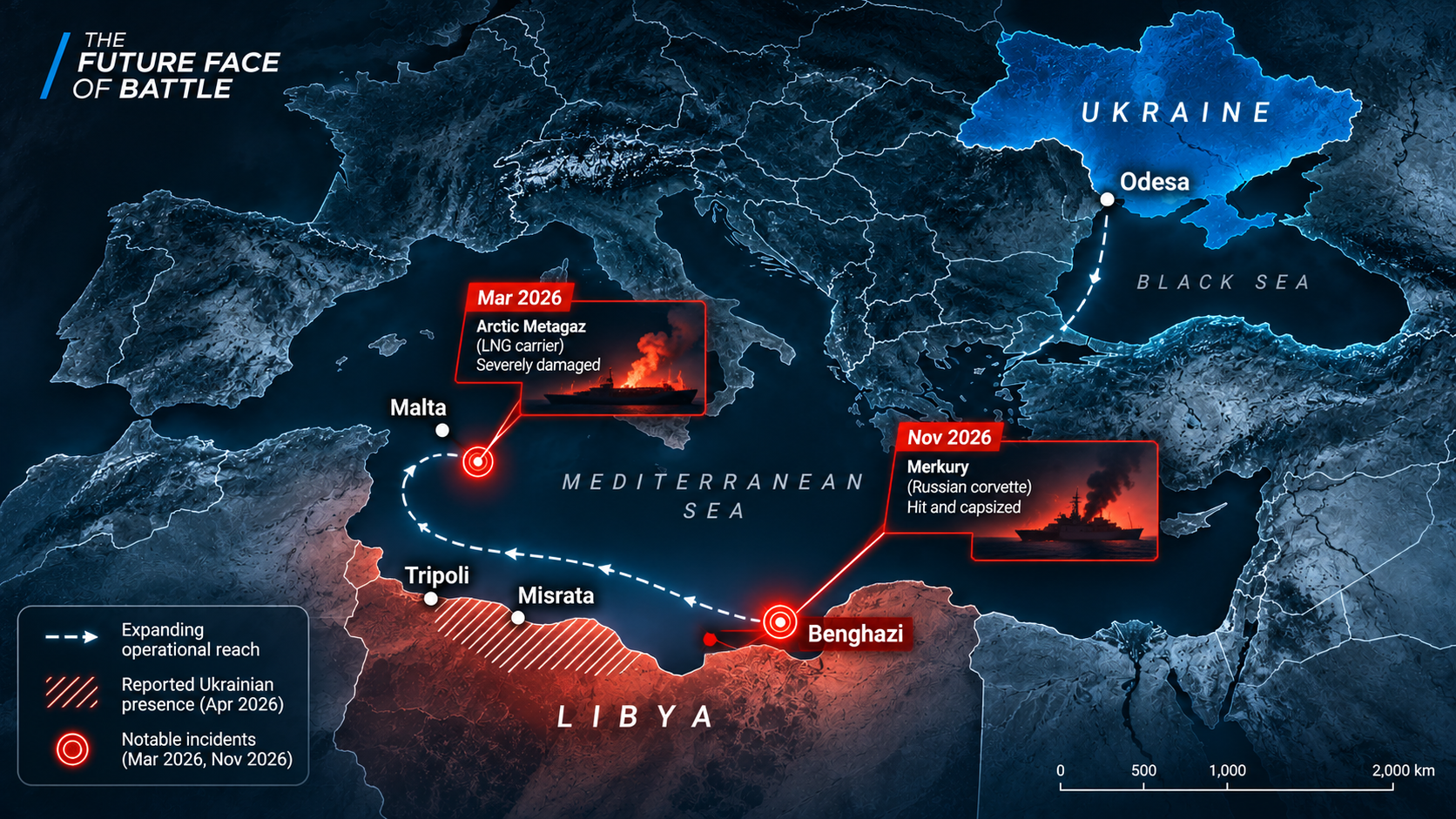
On November 22, 2026, the Russian Navy corvette Merkury was struck while docked at the port of Benghazi in eastern Libya. According to Libyan military officials, six suspected Ukrainian unmanned surface vessels (USVs) participated in the attack. Four were intercepted, while two reportedly reached the warship. Satellite imagery subsequently showed the corvette capsized and largely submerged alongside the pier. Ukraine has not claimed responsibility, and the precise circumstances of the attack remain under investigation.
The incident follows several attacks against Russian-linked shipping outside the Black Sea, including the Russian LNG carrier Arctic Metagaz, which was severely damaged near Malta in March 2026. Together, these incidents suggest that Ukraine's maritime drone campaign may be evolving from a regional effort to challenge Russia's Black Sea Fleet into a capability to attack Russian naval and commercial assets across distant maritime theaters.
The development raises an important operational question. How can a country without a substantial conventional navy conduct maritime strikes more than 2,000 kilometers from its own shores?
From Black Sea Operations to the MediterraneanUkraine's use of USVs has evolved rapidly since the first attacks against Russian naval facilities in 2022. Early systems were primarily explosive boats intended to approach and strike enemy vessels. Subsequent generations, including the Magura and Sea Baby families, introduced greater endurance, improved communications, larger payloads, and more diverse mission configurations.
As examined in the earlier Future Face of Battle article, How Ukraine's USVs Are Changing Naval Warfare, these platforms have expanded beyond one-way attacks into reconnaissance, air defense, and other naval missions.
The Mediterranean incidents introduce a different dimension: geographic reach.
In March 2026, the Russian LNG carrier Arctic Metagaz, transporting approximately 61,000 tons of liquefied natural gas, was severely damaged in an attack near Maltese waters. All 30 crew members were rescued. In April, Libyan officials told the Associated Press that Ukrainian forces operating from western Libya had conducted the strike using maritime drones.
The Benghazi incident suggests a possible continuation of this activity. Unlike the earlier attack against a commercial tanker, the latest operation targeted a Russian naval combatant inside a port. Reports also described an attack against a Russian-linked cargo vessel near Benghazi around the same time, although details of that incident remain less certain.
Extending Range Without Extending EnduranceA maritime drone operating thousands of kilometers from Ukraine does not necessarily need the fuel capacity or endurance to travel that distance independently.
In April 2026, an investigation by French broadcaster RFI reported that more than 200 Ukrainian military personnel and specialists were operating in Libya, with some reportedly stationed near Misrata. The investigation connected this presence to the attack against Arctic Metagaz. Libyan officials subsequently made similar allegations to the Associated Press.
If these accounts are accurate, the Ukrainian maritime campaign has adopted a model based on forward deployment rather than exclusively on long-distance navigation from Ukrainian territory.
This distinction changes the operational problem. Instead of developing a USV capable of independently crossing much of the Mediterranean, a military force can potentially deploy platforms and operators closer to the intended operating area. The range required of the individual vessel becomes substantially shorter, while its effective strategic reach expands.
Such operations still require an extensive supporting infrastructure. Unmanned vessels must be transported, prepared, maintained, and controlled. Maritime targets must be located and tracked, and operators require reliable communications and situational awareness. A vessel's ability to navigate toward a distant position is not equivalent to its ability to locate and engage a moving target.
Satellite communications and onboard navigation can support operations beyond the range of conventional line-of-sight radio links. Greater onboard autonomy could also reduce the need for continuous operator input. However, public reporting has not established the precise navigation, targeting, or control arrangements used in the Mediterranean attacks.
The distinction between remotely operated and autonomous systems remains important. A USV capable of navigating between predetermined waypoints does not necessarily possess the ability to independently identify a hostile vessel or authorize an attack.
A New Form of Maritime Force ProjectionThe strategic significance of the Mediterranean operations extends beyond the destruction of individual ships.
Traditionally, conducting naval attacks far from home required access to major surface combatants, submarines, long-range aircraft, or established overseas bases. Unmanned systems potentially offer another approach, combining relatively small strike platforms with distributed logistics, intelligence, and command capabilities.
Ukraine's reported operations in Libya demonstrate how access to a forward operating location could allow a military force to threaten ships in a distant theater without deploying a conventional naval task force.
The concept is not entirely new. Naval warfare has long relied on forward bases, clandestine operations, and small attack craft. What changes with USVs is the separation between the weapon and its operator, potentially allowing a relatively small platform to conduct a mission without exposing a crew during the final approach.
This arrangement also creates new dependencies. Forward-deployed platforms require local infrastructure, access to communications, and some degree of cooperation or tolerance from authorities controlling the territory. Their presence may create political complications, particularly in a country such as Libya, where competing governments and foreign military interests operate in different regions.
The Benghazi incident illustrates these complications. Russia maintains close relationships with eastern Libyan authorities, while the reported Ukrainian presence is concentrated in western Libya. A maritime drone campaign directed against Russian assets therefore risks extending the Russia-Ukraine conflict into an already fragmented regional security environment.
Implications for Naval DefenseThe reported attack on Merkury also highlights the difficulties of protecting naval vessels against small unmanned threats.
According to Libyan officials, most of the attacking drones were intercepted. Nevertheless, the remaining vessels reportedly inflicted enough damage to disable and sink the corvette. The reported sequence suggests that successful interception of individual USVs does not necessarily prevent an attack from achieving its objective.
Ports present a particularly difficult defensive environment. Commercial vessels, harbor traffic, small boats, and fixed infrastructure complicate surveillance and identification. Defensive systems must distinguish potential threats from legitimate maritime activity, often at short ranges.
The challenge becomes greater when the possible launch area is not confined to the coastline of an openly hostile state. Forward-deployed unmanned systems could expose ships to threats in ports and maritime regions previously considered distant from an active conflict.
At the same time, the Mediterranean incidents do not yet establish that Ukraine can conduct sustained, large-scale USV operations across the region. The number of platforms available, their operational reliability, and the extent of their supporting infrastructure remain unknown.
Nor does the successful attack against a vessel in port necessarily demonstrate an equivalent ability to engage a maneuvering warship at sea.
Beyond Platform RangeUkraine's Black Sea campaign demonstrated that relatively inexpensive unmanned vessels could threaten a much larger conventional fleet. The reported operations in Libya suggest that the next development may concern how these platforms are deployed, rather than simply how far they can travel.
Forward operating locations, distributed command arrangements, maritime intelligence, and remotely controlled strike platforms can combine to extend the reach of a force without requiring every weapon to possess intercontinental endurance.
The implications extend beyond Ukraine. Militaries developing USVs will need to consider not only platform performance, payload capacity, and autonomy, but also the infrastructure required to deploy and sustain unmanned operations far from home.
For defending navies, the challenge is equally significant. A vessel may face unmanned threats even when operating thousands of kilometers from the adversary's territory.
The emerging lesson is that the effective range of unmanned maritime warfare may increasingly be determined by the reach of the network supporting the vessel, rather than the endurance of the vessel itself.
Explore stories by subject ↗