
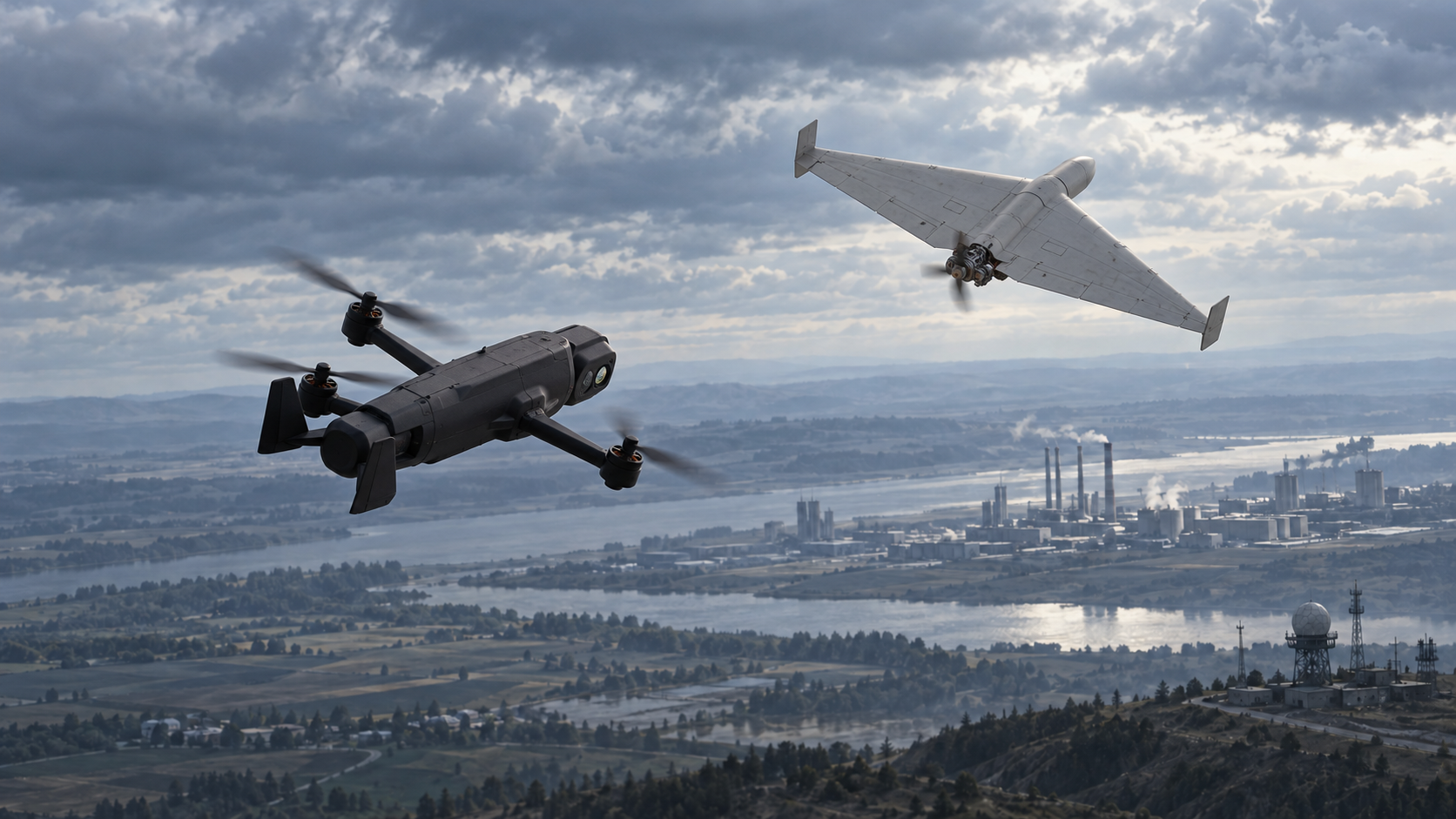
Drones are increasingly being developed to hunt other drones. Instead of relying exclusively on ground-based missiles, guns or electronic warfare, defenders can launch an unmanned aircraft to pursue and disable an incoming threat. The interceptor becomes an airborne weapon, using its own sensors and flight controls to close the distance before striking by collision, detonating a warhead or deploying a net.
Recent announcements show several versions of this drone-on-drone approach. Indra’s DRIZZLE family is intended to counter mass drone attacks. ORIGIN Robotics’ BLAZE combines autonomous flight and target tracking with operator-confirmed engagement. IMPACT’s HUNTER launches from a box at the protected site and attempts to ram its target. ParaZero’s interceptor-mounted net pods offer a physical capture mechanism without an explosive interceptor warhead.
The attraction is both operational and economic. An airborne interceptor can pursue a threat beyond the immediate reach of a fixed defensive weapon, while potentially reducing reliance on expensive missiles. But the category covers different missions. Defeating a small quadcopter near a military position is a different problem from intercepting a long-range attack drone approaching critical infrastructure. Speed, endurance, sensors and the method of neutralisation must match the target.
The emergence of these systems suggests that unmanned aviation is acquiring its own air-defence layer. The central question is whether a defending drone can consistently find, identify and defeat another aircraft under conditions that neither side fully controls.
The first challenge is establishing what to attack. Small drones can be difficult to distinguish against terrain, buildings or other airborne objects. Radar can provide a track, while electro-optical and infrared cameras help classify the aircraft. Radio-frequency detection can contribute when the target transmits signals, but offers less assistance against a drone flying without an active radio link.
The technological response is to combine external detection with onboard sensing. A ground sensor can direct an interceptor toward the target area, after which the aircraft’s own cameras take over tracking. BLAZE, for example, uses radar-assisted approach followed by electro-optical or infrared tracking and AI-supported target acquisition. This division allows the interceptor to benefit from a wider surveillance picture while maintaining a local view during the final approach.
However, recognising a drone does not establish that it is hostile. Friendly reconnaissance aircraft and authorised civilian drones may occupy the same airspace. Sensor fusion can improve confidence about an object’s location and appearance, but engagement also requires information about ownership, permissions and operational context. Errors at this stage can turn a technically successful interception into an attack on the wrong aircraft.
The next challenge is deciding how to respond, particularly when several threats arrive together. Defenders must prioritise targets, assign interceptors and avoid sending multiple aircraft after the same drone while leaving another unchallenged. They must also preserve enough capacity for subsequent waves.
ORIGIN’s announced cooperation with Anduril addresses this requirement through planned integration with the Lattice command platform. The agreement points toward linking surveillance and interception within a shared command system. It does not establish that the combined capability is already operational, but it illustrates why a drone interceptor needs to function as part of a coordinated defence.
Automation can shorten the time between detection and pursuit, yet authority to engage remains a separate issue. ORIGIN describes operator-confirmed engagement and an ability to wave off BLAZE before its final attack phase. Such details are more useful than a broad claim of autonomy: automatic launch, autonomous flight, target tracking and permission to use force are distinct functions.
After authorisation comes the physical problem of catching another aircraft. An interceptor must accelerate, reach the target and maintain a usable track while both aircraft move. Maximum speed matters, but so do launch delay, manoeuvrability and endurance. A fast interceptor with insufficient energy to complete the pursuit may still fail.
Indra reports that DRIZZLE exceeds 400 km/h and has a range of approximately 80 kilometres, with deployment from a carrier drone potentially extending its reach. IMPACT reports a maximum speed of 300 km/h for HUNTER and a design speed of 825 km/h for its turbine-powered SABLE, which remains in development. These figures describe manufacturer ambitions and specifications; they do not independently establish interception performance.
Electronic warfare complicates the pursuit further. Satellite navigation may be jammed, and the link between the interceptor and its operator may deteriorate. The technological mitigation is to move more navigation and tracking functions onboard. IMPACT describes visual navigation for operation without GNSS, alongside electro-optical and long-wave infrared terminal guidance.
Tycho.AI’s USSOCOM development programme similarly targets a small interceptor capable of operating in communications-denied conditions. The contract covers ten prototypes over twelve months, making it a development effort rather than a fielded capability. Onboard autonomy can reduce dependence on external signals, although visual systems still face poor visibility, difficult backgrounds and uncertainty about the target.
The final encounter brings another set of trade-offs. Ramming requires a collision that causes enough damage to stop the hostile aircraft. It also consumes the interceptor and can produce falling debris. An explosive warhead can disable a target without direct contact, but adds requirements for safe arming and control of the engagement.
Net-based interception offers a different mechanism. ParaZero has announced orders for interceptor-mounted net pods, which physically entangle the target. Avoiding an explosive interceptor warhead can be advantageous in some settings, but the net must still reach and capture a moving aircraft. If that aircraft carries explosives, capture does not remove the danger.
Nets are also appearing in complementary ground-based systems. Ukraine’s Phantom Defence unveiled Mangal at IT Arena, describing a launcher with six net cartridges, two cameras and automatic target detection to assist the operator. It can be installed at fixed positions or on vehicles. Mangal is therefore a local defensive layer rather than a drone-on-drone interceptor, and its presentation should not be confused with verified combat performance.
The engagement does not end with apparent contact. A damaged drone may continue flying, and an aircraft brought down over a facility can still cause harm. Continued tracking and observation are needed to confirm defeat and identify where the target falls. Retrieval of an armed drone may require specialist handling, even when a net preserves much of the aircraft intact.
The defender must then prepare for the next attack. A reusable interceptor needs to return, undergo inspection and be recharged or reloaded. An interceptor destroyed in a collision must be replaced. These requirements become decisive during sustained attacks, when the stock of ready aircraft and the rate of replenishment can matter as much as an individual interceptor’s performance.
IMPACT’s subscription model explicitly includes hardware, reloads and monitoring, treating protection as an ongoing service. But its announcement does not establish automatic replenishment or sustained performance against mass attacks. A launcher that operates without a crew standing beside it still depends on maintenance, replacement stocks and functioning sensors.
Drone-on-drone interception could change how air defence is distributed, bringing an airborne defensive capability closer to individual positions and facilities. Its effectiveness will depend on the entire chain supporting the encounter. The systems that matter will be those that can identify the correct aircraft, sustain pursuit under disruption, confirm its defeat and remain ready when another drone arrives.
Explore stories by subject ↗