
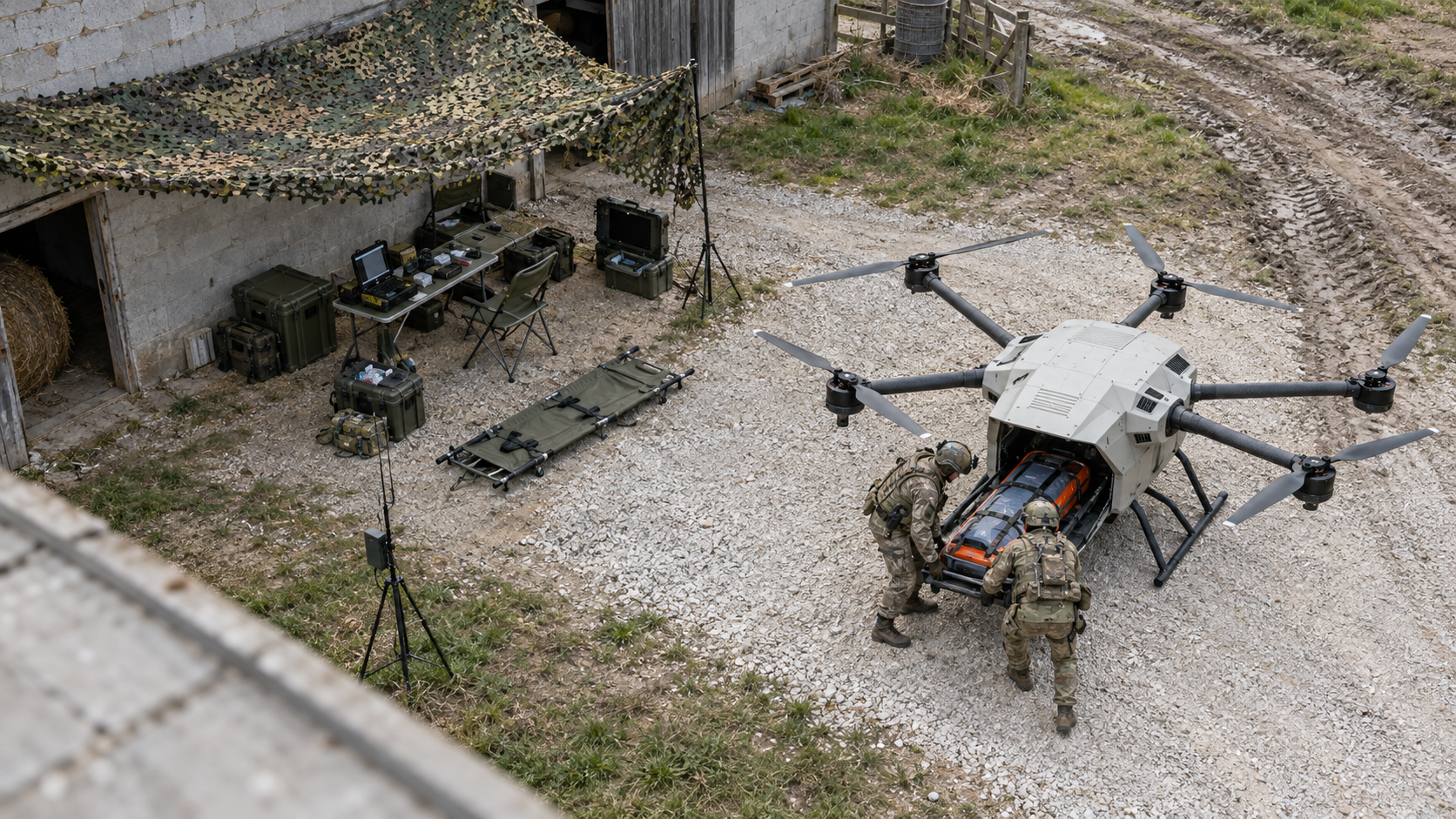
Ukraine has spent much of the war adapting commercial and military drones to reconnaissance, strike and logistics missions. SkyFall’s StarGate represents a different and more difficult ambition: using an unmanned aircraft to retrieve wounded soldiers from areas where ambulances, armored vehicles and crewed helicopters may be too vulnerable to enter.
According to reporting by the Associated Press, the system was developed over roughly a year after a request from the commander of Ukraine’s 475th Separate Assault Regiment, known as Code 9.2. A prototype has now been handed to a combat brigade for frontline evaluation. That distinction matters. StarGate is not yet a proven medical evacuation system, and several of its most important performance claims still come from the manufacturer.
The aircraft uses six rotors and carries a medical module built around a stretcher. SkyFall says it can lift up to 150 kilograms, fly about 15 kilometers one way, cruise at roughly 65 kilometers per hour and reach a maximum speed of 105 kilometers per hour. The company says a team can prepare it for flight in about ten minutes. Its expected price is at least $50,000, while the manufacturer has set an ambitious production target of as many as 1,000 units per month by the end of 2026.
A Machine Built for the Kill Zone
The operational logic is straightforward. In parts of the Ukrainian front, persistent drone observation and rapid precision fires have created a contested belt extending roughly 10 to 15 kilometers behind the forward line. Vehicles entering this area can be detected and attacked quickly. As a result, ground evacuation may take hours and, in extreme cases, much longer. A remotely operated aircraft could shorten that journey while avoiding the need to expose an ambulance crew or helicopter team.
StarGate is primarily manually controlled, but SkyFall says artificial intelligence assists navigation when satellite positioning is unavailable, spoofed or jammed. The aircraft reportedly uses two communications paths: Starlink and the company’s proprietary L-Link. If both links fail, the manufacturer says the drone can calculate a return route. These features are central to the concept, because a casualty evacuation aircraft that becomes lost or immobilized under electronic attack could turn a rescue attempt into another recovery mission.
During a demonstration observed by the Associated Press, the aircraft operated under simulated jamming and faced attacking FPV drones. StarGate launched a net toward one of them and diverted it. SkyFall also claims that the aircraft can remain controllable after losing one rotor arm. Neither claim should yet be treated as combat-proven. Survival in a demonstration is not the same as repeated operations under artillery fire, electronic warfare and deliberate interception.
Not the First Flying Ambulance Drone
StarGate is part of a longer effort to remove crews from dangerous casualty evacuation missions. Israel’s Tactical Robotics developed the Cormorant, previously known as AirMule, around internal ducted fans and a cabin designed to carry two casualties. The aircraft demonstrated cargo delivery and the evacuation of a medical mannequin for the Israel Defense Forces in 2018, but it did not mature into an operational system.
In the United States, Dragonfly Pictures developed the tandem-rotor DP-14 Hawk with an internal bay large enough for a stretcher and a payload of approximately 195 kilograms. The platform was studied for resupply and casualty evacuation but remained developmental. In 2022, DARPA and Sikorsky demonstrated a crewless Black Hawk that could be redirected in flight, land for a simulated casualty pickup and transmit medical information through the BATDOK system. That experiment proved a higher-end autonomous rescue concept, but it relied on a full-size helicopter whose cost and logistics are far removed from an attritable frontline drone.
Germany’s Avilus is pursuing the Grille, an unmanned evacuation aircraft integrated into the iMEDCAP medical chain. During NATO’s Vigorous Warrior 2026 exercise, the broader concept linked robotic search, diagnosis, ground evacuation and air transport. Avilus lists a 175 kilogram payload and a 50 kilometer range, and the Bundeswehr has ordered two demonstrators.
What distinguishes StarGate is therefore not the idea of an unmanned flying ambulance. It is the attempt to tailor that idea to the Ukrainian battlefield, where low-cost FPV interceptors, dense electronic warfare and short warning times shape every movement near the front. In doctrinal terms, the aircraft is also closer to CASEVAC than full MEDEVAC if it merely moves a casualty without providing meaningful medical care in flight.
Can an Unmanned Aircraft Be Protected as Medical Transport?
International humanitarian law does not make protection depend on whether a vehicle contains a human pilot or doctor. Additional Protocol I defines medical transportation broadly and allows military or civilian means of transport, permanent or temporary, when they are assigned exclusively to medical purposes and placed under the control of a competent authority. On that basis, an unmanned aircraft can potentially qualify as protected medical transport.
The emblem is important, but it is not magic. A Red Cross, Red Crescent or Red Crystal marking helps the opposing side identify a medical platform, yet the marking alone does not create protected status. Authorization, exclusive medical use and compliance with the rules governing medical aircraft matter more. In contested areas, advance agreement on routes, times and identification procedures can be critical, as can compliance with lawful requests to land or submit to inspection.
The protection is also conditional. It may be lost if the aircraft is used to collect intelligence, transport ammunition or able-bodied fighters, serve as an operational communications relay, or otherwise commit acts harmful to the enemy outside its humanitarian function. StarGate’s defensive net launcher therefore creates a genuine legal and philosophical gray area. A limited, nonlethal means of self-protection may not automatically erase medical status, but a system that actively participates in combat could become a lawful target.
The deeper problem is one of recognition. Combatants are being trained to treat unfamiliar drones as threats because many observation, strike and relay platforms look similar. A machine carrying a wounded person may be legally analogous to an ambulance, but it approaches through the same low-altitude airspace as hostile FPV drones. Protection will depend not only on legal categories but also on credible markings, predictable behavior, technical identification and restraint by soldiers operating under intense time pressure.
The Test That Matters
StarGate’s frontline evaluation will not be decided by a single successful flight. The relevant questions are whether it can arrive, land and return reliably under jamming and spoofing; whether infantry units can load casualties quickly; whether operators can maintain communications without revealing their position; and whether the aircraft can be distinguished from combat drones by both friendly and opposing forces.
If it works, the system could reduce evacuation time without sending additional personnel into the kill zone. If it fails, the limits may be operational rather than aerodynamic. Medical evacuation is a chain, and the drone is only one link. The real breakthrough would be a trusted system that connects casualty detection, triage, routing, communications and protected transport under combat conditions. Ukraine is now testing whether that chain can remain intact when its most visible component is a robot.
Explore stories by subject ↗