
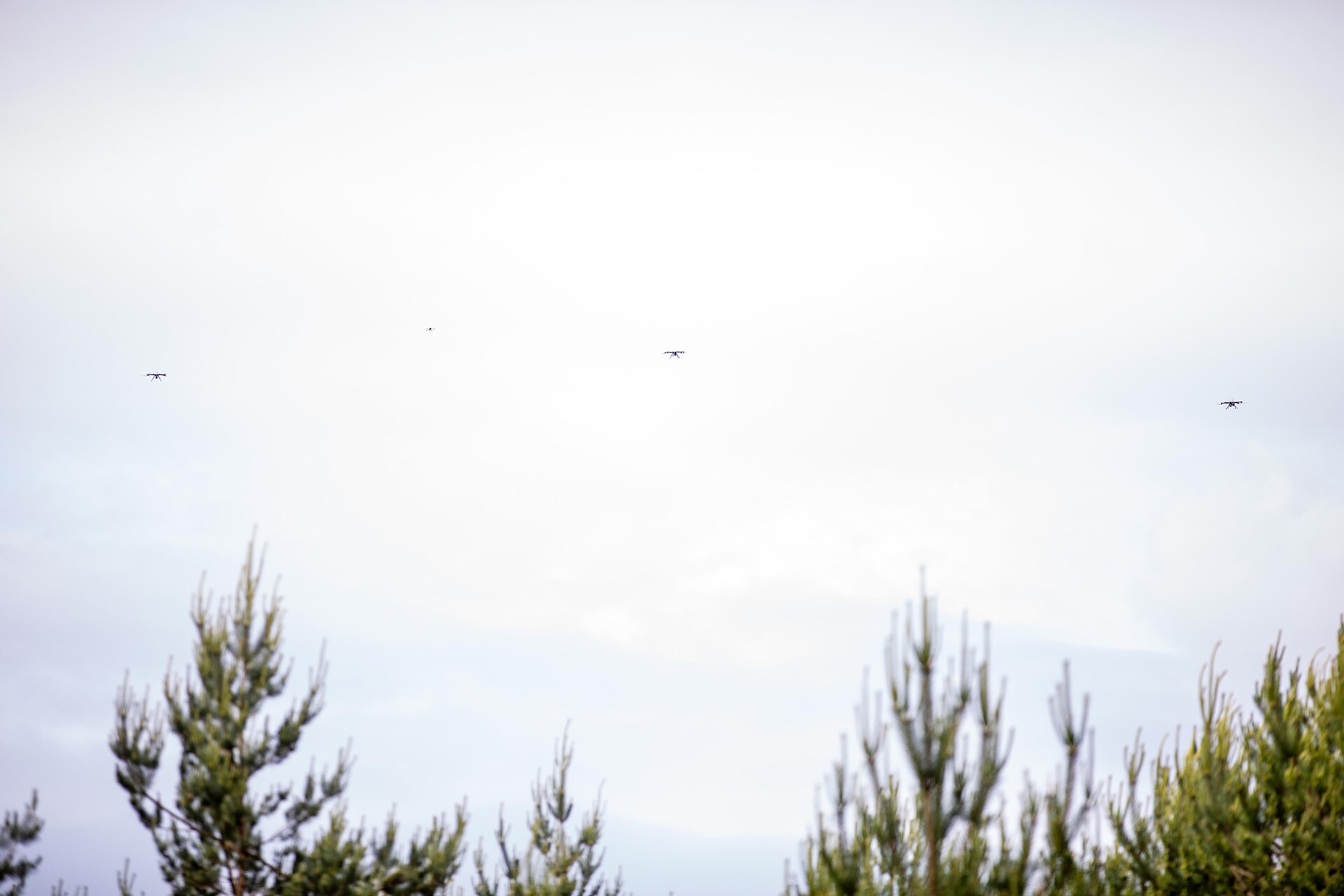
The UK Ministry of Defence has launched a competition that will give up to 12 British companies access to data collected on the battlefield in Ukraine. The companies will use it to develop AI systems for swarms of drones and other uncrewed vehicles that can coordinate missions without satellite navigation and under disrupted communications. This is not yet an operational swarm. It is a development programme that will test whether Ukraine’s battlefield experience can be turned into new military systems.
The data comes from Avengers AI Labs, a platform established by Ukraine’s Ministry of Defence to train, test and improve military AI models. Despite its name, it is more than a physical laboratory. It is a data repository and development environment connected to the DELTA battlefield management system. DELTA brings together information from drones, cameras and other sensors, allowing units to share a common operating picture, mark targets and coordinate their activities.
At the heart of the platform is a labelled dataset collected under combat conditions. In August, Ukraine’s Ministry of Defence said it contained around five million annotated images. The new British announcement refers to more than six million object detections, including tanks, artillery, air defence systems, soldiers, Shahed drones and reconnaissance vehicles. The difference may reflect the continued accumulation of data, but it may also result from different counting methods: a single image can contain several identified objects.
According to Ukraine’s Ministry of Defence, a model trained on the dataset has already been integrated into DELTA and analyses more than 100,000 drone video feeds each month. Ukraine says the system identifies around 70 percent of targets in real time and can work with both daylight footage and thermal imagery. These figures have not been published as part of an independent assessment. It is also unclear how a “target” was defined, what the false-positive rate is, or how performance varies across different conditions. In an earlier demonstration, Ukraine said Avengers could identify a military vehicle in video in about 2.2 seconds.
British access to Avengers AI Labs stems from an agreement on defence AI cooperation signed in Kyiv on 24 August 2026. The agreement made the UK the first foreign country to gain access to the platform. Its aim is to bring together Ukraine’s battlefield data and operational experience with British companies, researchers and engineers to develop systems for the armed forces and national infrastructure of both countries.
The swarm competition is only one part of the agreement. Two other pilot projects have already been announced. The first examines the use of fibre-optic cables as distributed sensors that, with AI, could detect movement, vehicles or unusual activity around bases, railways, airports, energy facilities and other sensitive infrastructure. The second focuses on energy-efficient AI chips that could run detection and autonomy functions directly on drones and robotic vehicles, without constant reliance on a remote server. Sintela, Mind Foundry and Skyral are among the companies involved in the initial pilots.
In the new competition, companies will focus on four capabilities: detecting, classifying and tracking targets; making distributed decisions without a single control centre; changing routes and priorities during a mission; and combining information from multiple vehicles and sensors. The idea is that a swarm could divide tasks among its members and continue operating when some vehicles are lost, communications are disrupted or GPS signals are blocked.
Real-world data could offer a significant advantage over information gathered on a controlled test range. Footage from Ukraine includes camouflage, smoke, weather, electronic interference, difficult camera angles and an adversary actively trying to avoid detection. But a large dataset does not guarantee a reliable model. The data may be biased towards particular front lines, sensor types and targets common in Ukraine. A system that performs well there may not perform as well in another theatre.
The most sensitive issue is the transition from identifying targets to making decisions. The British announcement promises “appropriate human involvement” but does not explain who would authorise a strike, what explanations the model would provide, or how incorrect recommendations would be checked. Automated target identification is not the same as autonomous use of weapons. It does, however, influence what an operator sees, what receives priority and how much time remains to challenge the system’s recommendation.
Proposals for the competition are due by 22 October, and selected companies are expected to be notified by 6 November. Development will begin only after that. The development today, then, is not a drone swarm already proven in combat. It is the opening of one of the world’s most important military datasets to British industry. The agreement gives the UK access to operational experience that is difficult to reproduce in a trial, while giving Ukraine access to British research, chip development and industry. Its success will be measured not by the number of images in the dataset, but by whether those images can be turned into reliable, controllable systems that can withstand conditions in which a detection error could become a lethal decision.
Explore stories by subject ↗