
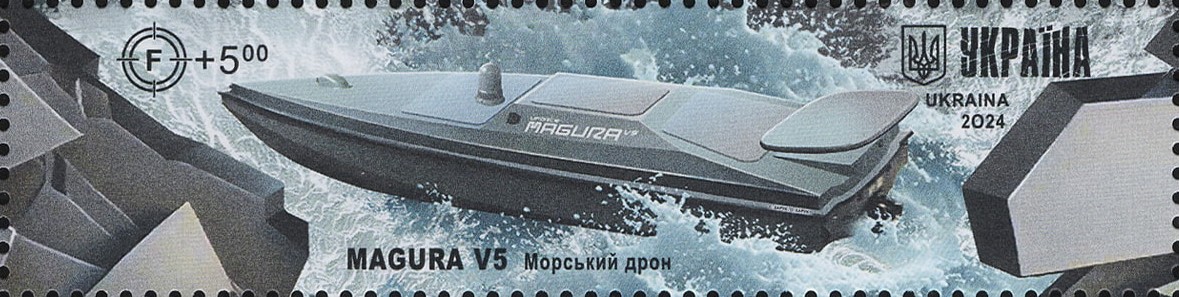
In less than four years, Ukraine has brought about a true revolution in naval warfare. A country that entered the war against a Russian fleet superior in both numbers and capabilities has managed to develop a new combat doctrine based on uncrewed surface vessels (USVs). While at the outset these were primarily "explosive boats" designed to strike enemy ships, today they constitute an entire family of autonomous platforms carrying out strike, intelligence, electronic warfare, defense, and even drone-launching missions. The rapid pace of development and operational successes are currently attracting interest from militaries and defense industries worldwide—including the United States Navy.
One of the most prominent developments is the Sirena, unveiled at the Eurosatory 2026 exhibition. Unlike the first generations of Ukrainian vessels, the Sirena is not a single-use weapon but a multi-role platform based on a trimaran hull, which provides high stability even in harsh sea conditions. The vehicle is capable of operating autonomously, via remote control, or through a combination of both.
It is equipped with a wide-band electronic warfare system capable of jamming communications, satellite navigation, and drone control, a Pelican V1 radar, and a Sea Dragon missile launcher. It can carry a payload of up to 300 kg, remain at sea for approximately 24 hours, and operate at a range of hundreds of kilometers. The combination of these capabilities transforms it from a suicide platform into a naval combat vehicle capable of surviving, locating targets, and defending itself against electronic and aerial threats.
Alongside the larger vessels, Ukraine is also developing a new generation of small, low-cost watercraft that can be produced in large quantities and operated in swarms. One of these is the Harpun, developed by NOAH X. It is only about two meters long and weighs around 100 kg, but despite its small dimensions, it has already been successfully tested against Russian targets and is in the process of being adopted by the Ukrainian military.
The Harpun is capable of carrying a payload of up to 30 kg and loitering in the target area for up to 48 hours before receiving a strike order. This capability allows it to be positioned in advance in the area of operation and activated only when a suitable target is identified. Powered by a water-jet engine, the vehicle reaches a speed of about 35 km/h, has a range of about 40 km, and is equipped with three separate communication channels, allowing it to switch between them quickly in the event of electronic jamming attempts. In addition to the strike version, logistic variants for transporting equipment and supplies have also been developed, as well as a version designed for underwater reconnaissance missions using sonar.
According to a comprehensive review by The Defender, the Ukrainian evolution is not limited to developing new models, but involves a profound shift in operational doctrine. While at the beginning of the war the vessels were primarily intended to ram Russian ships, today they perform intelligence, reconnaissance, electronic warfare, maritime security patrols, and coordinated strikes as part of an integrated system. Each operation provides fresh operational experience, which is rapidly incorporated into the next generation of vessels.
One of the most innovative directions is turning the vessels into launch platforms for UAVs. According to a report by Defense News, Ukraine is already operating strike drones launched from a variety of platforms, including uncrewed surface vessels in the Black Sea. This makes it possible to bring the drones closer to the target, extend their operational range, and bypass air defense systems by attacking from unexpected directions. In other words, the vessel is no longer the weapon itself, but a floating launch base for additional strike systems.
At the same time, Ukraine continues to expand the capabilities portfolio of its uncrewed surface vessels. The new models integrate electronic warfare systems, advanced sensors, radars, jam-resistant communications, and even advanced artificial intelligence-based autonomous capabilities. The goal is to enable the vessels to continue their mission even when communication with the operator is lost or when satellite navigation systems are jammed.
Ukrainian success is not going unnoticed by the world. Recently, the Indo-Pacific region hosted the United States' first trial of a vessel from the MAGURA family. Now, the cooperation is moving to a significantly broader stage: in July 2026, UFORCE, a company of Ukrainian origin now operating out of Britain, announced an agreement with American vessel manufacturer RECONCRAFT to produce MAGURA vessels on US soil.
The agreement was signed at a ceremony held at the Ukrainian Embassy in Washington. RECONCRAFT, which manufactures vessels for US special forces and partner militaries, will combine its manufacturing capabilities with the technology and operational experience accumulated by UFORCE in the Black Sea. According to reports, the goal is to establish a production capacity in the United States of hundreds or even thousands of MAGURA vessels per year, at facilities in Oregon and South Carolina. This is still a cooperation agreement rather than a US procurement order of that scale, but the very objective illustrates the ambition to transform a platform developed out of urgent operational need into a product manufactured at industrial scale. (Tectonic Defense)
The MAGURA family is considered one of the prominent success stories of Ukrainian military innovation. According to UFORCE, the vessels have contributed to the destruction of more than a dozen Russian watercraft in the Black Sea, and the family also includes a platform that successfully shot down manned aircraft in combat. One of the MAGURA models is about 7.6 meters long, has a payload capacity of about 770 kg, and a range of more than 560 km. It can be operated as a one-way attack vessel, a drone-launching platform, or for intelligence, surveillance, and reconnaissance (ISR) missions. The price of such a strike vessel is reported to be under half a million dollar—a fraction of the price of the warships it is designed to threaten. (Tectonic Defense)
The partnership is not limited to watercraft. UFORCE also plans to offer the US market uncrewed aerial and ground systems, autonomy software, and command and control systems. The company itself brings together nine Ukrainian defense firms, representing an effort to turn the decentralized innovation developed during the war into a unified industry capable of raising capital, scaling up production, and competing in Western markets. According to the company's announcement, combining Ukrainian technology with US manufacturing capacity aims to shorten the path from a system that has already proven itself on the battlefield to an available operational capability for US forces. (UFORCE announcement)
The deal illustrates a broader shift in the status of the Ukrainian defense industry. Ukraine is no longer viewed merely as a consumer of Western weapons or a testing ground for foreign technologies. It is becoming a supplier of knowledge, systems, and operational concepts born out of intense combat against an advanced adversary. The transition from US trials of the MAGURA vessel to planned production in the United States indicates that the knowledge accumulated in the Black Sea is beginning to integrate into the Western defense industrial base.
Within just a few years, Ukraine has managed to turn its naval weakness into a technological advantage. A combination of innovation, rapid adaptation to battlefield needs, and the development of a wide range of platforms—from tiny 100 kg vessels to advanced systems like the Sirena and the MAGURA family—has made it one of the leading nations in the world in the field of uncrewed maritime systems. The fact that Ukrainian systems are set to be manufactured in the United States demonstrates that this is no longer a localized solution for the Black Sea war, but a technology influencing the force buildup and defense industry of other superpowers. The trend is clear: the future of naval warfare relies not only on frigates and destroyers, but also on swarms of autonomous, inexpensive, smart, and hard-to-detect watercraft.
Explore stories by subject ↗