
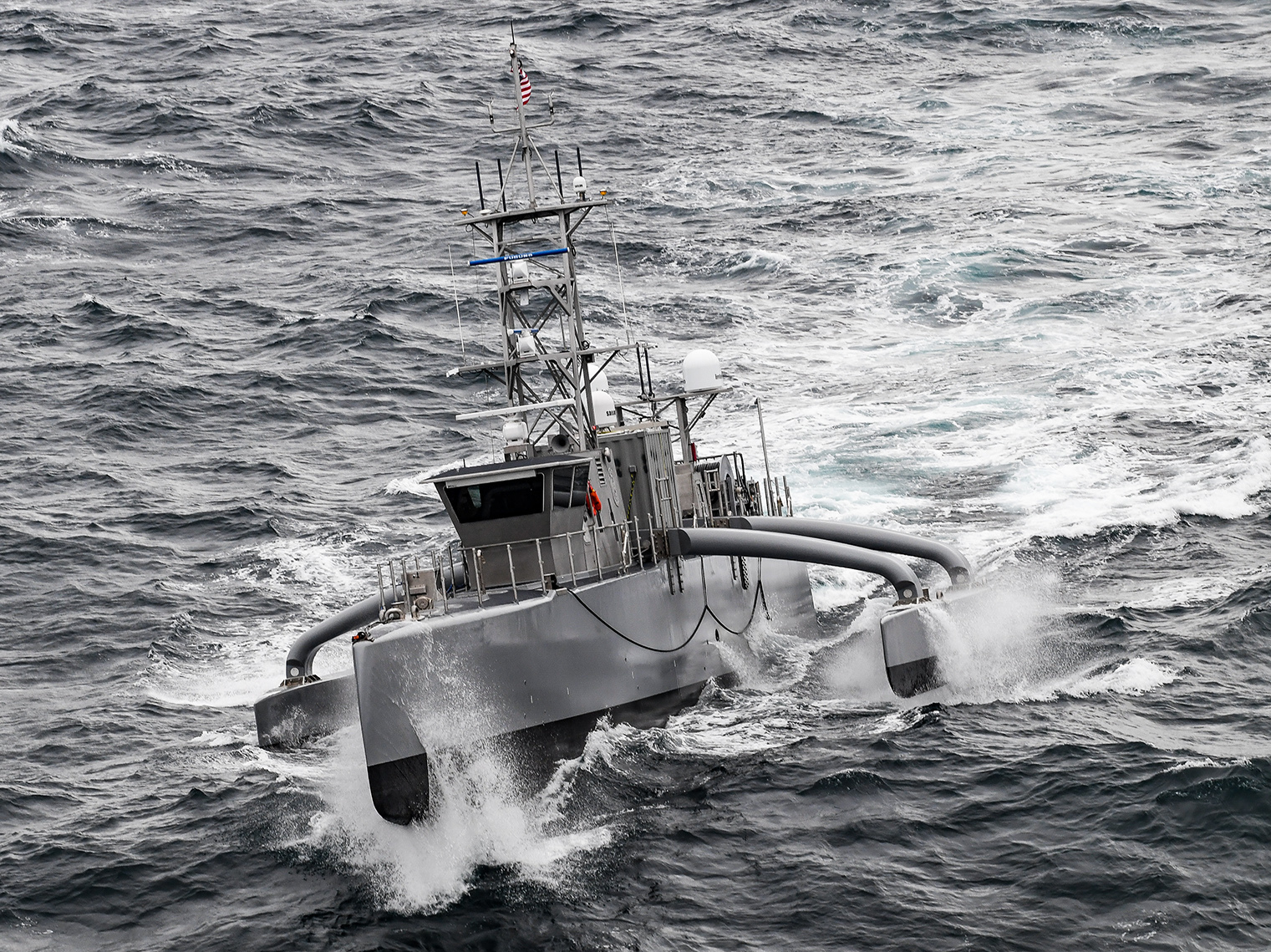
On 12 September, the Ukrainian Navy released footage of what it described as the first naval battle in history between two uncrewed surface vessels (USVs). According to the Ukrainian statement, a Sargan-3000 USV equipped with a remotely operated weapon station intercepted and destroyed a Russian attack USV in the Black Sea. The video does show a Ukrainian vessel firing at a small target on the water, but several key details still rest on one side’s account and visual analysis of the footage.
The Ukrainian Navy said that units of Ukraine’s military intelligence agency, HUR, first located the Russian vessel. A drone used for surveillance may have tracked the target, although the statement did not specify its precise role. Following the detection, a Sargan-3000 was deployed against it. The Ukrainian vessel carried a Kongsberg PROTECTOR RS4 weapon station fitted with a 12.7 mm heavy machine gun. In the video, the weapon station fires several bursts at the Russian vessel before it disappears amid spray and smoke.
Ukraine did not disclose when or precisely where the engagement took place. Naval warfare analyst H I Sutton estimated in an analysis published by Naval News that it probably occurred in the northwestern Black Sea, between Odesa and Crimea. This remains an estimate based on the known operating areas of Russian and Ukrainian vessels.
Sutton identified the target as an upgraded version of the Russian Orcan USV, also called Zefir in some sources. He said the vessel’s hull and propulsion features visible in the footage match that model. The Orcan is a small, fast, waterjet-propelled craft apparently designed to strike targets with an explosive charge. Russia has not confirmed the loss of the vessel or the engagement itself.
The claim that the Russian USV exploded also requires caution. The video shows impacts, smoke and a large splash, but does not necessarily show its explosive charge detonating. Specialist sources describe the vessel as having been hit and sunk. The rounds may have punctured its hull, disabled its engine, ignited fuel or damaged its control systems. A secondary detonation of the charge it carried is possible, but the released footage does not establish that it happened.
The loss of a single vessel is unlikely to be strategically significant on its own. Both sides have long used USVs for intelligence gathering and attacks, including one-way attack missions. The engagement nevertheless offers several broader lessons.
First, the Ukrainians appear to have completed the sequence from detection to interception against a small, fast enemy vessel. This is a substantially more demanding task than sending an explosive USV against a target, which appears to have been the Russian vessel’s mission. Second, the engagement suggests a high level of skill among the Ukrainian operators. Intercepting a fast target, hitting it while both vessels are moving and disabling it require considerable technical and operational proficiency. We can cautiously assume that the final manoeuvring and firing were carried out under remote human control rather than autonomously. If they were autonomous, the demonstrated capability would be more remarkable still.
Based on the available sources, this is best described as the first known and documented engagement between USVs, with the qualification that the footage was released by the Ukrainian Navy and supported by professional visual analysis. It is not definitive proof of a historical first. It may, however, mark the emergence of a new arena of naval warfare: robotic vessels, operating with partial or full autonomy, capable of taking on roles performed by crewed ships even in the demanding task of fighting another vessel.
Sources: Naval News, The Kyiv Independent, Interfax-Ukraine.
Explore stories by subject ↗