
Ukraine says it has used heavy-lift drones to deliver approximately four tonnes of food and medical supplies to 100 locations in Oleshky, a Russian-occupied town across the Dnipro River from Kherson. The operation, announced by the Kherson regional administration on 27 September, offers a striking image: aircraft carrying provisions into a place that vehicles can scarcely reach. It also raises an older question. When a population is cut off on the ground, can supply from the air keep it alive? www.pravda.com.ua
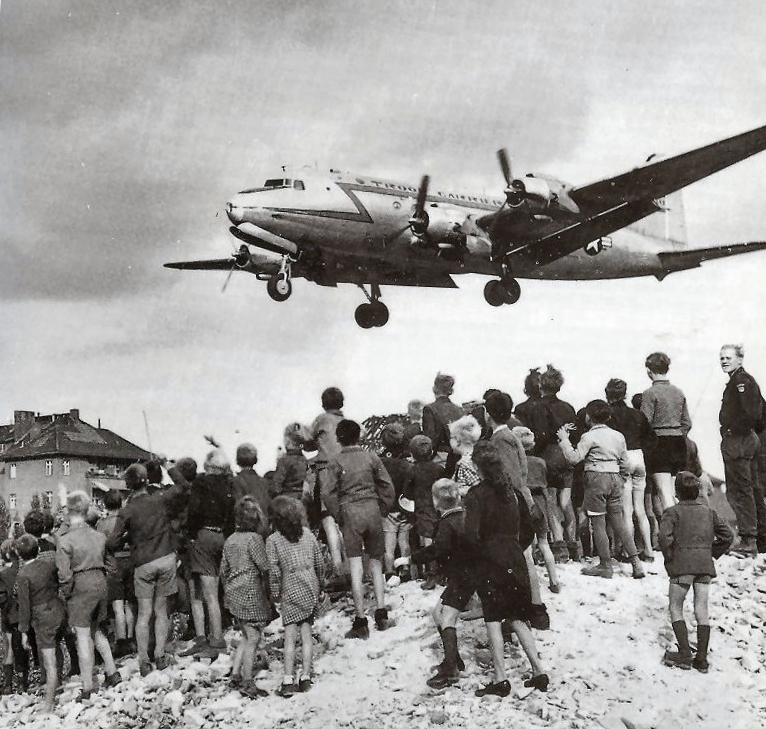
The Berlin Airlift provides the best-known example of a successful answer. In June 1948, the Soviet Union blocked road, rail and water access to the Western-controlled sectors of Berlin. The United States and its allies used aircraft to supply the city until the blockade was lifted in May 1949. That effort depended on established air corridors, functioning airports, large transport aircraft and a sustained logistical operation. Its achievement was measured in months of continuous deliveries, rather than in a single flight. history.state.gov
Điện Biên Phủ in 1954 illustrates a different side of the same problem. The French garrison in northwestern Vietnam depended on air supply. Once enemy fire made its runway unusable, aircraft had to drop reinforcements and provisions by parachute. Antiaircraft fire threatened the aircraft, while the area held by French forces kept shrinking. Contemporary US diplomatic reporting described the resulting difficulty of landing supplies accurately and recorded instances in which significant quantities fell into opposing hands. The garrison ultimately fell. www.cheminsdememoire.gouv.fr
Oleshky is neither West Berlin nor Điện Biên Phủ. Berlin was a city supplied through protected air corridors; Điện Biên Phủ was an encircled military position. The people awaiting aid in Oleshky are civilians living under occupation. The comparison concerns the logistics of isolation: an aircraft can cross a blocked route, but the delivery succeeds only if enough supplies land in the right places, reach the intended recipients and continue arriving. ukraine.ohchr.org
The need in Oleshky is well documented independently of the latest Ukrainian announcement. The UN Human Rights Monitoring Mission interviewed residents from Oleshky and nearby frontline communities who described food shortages, drone attacks and landmines obstructing deliveries and evacuation. On 25 September, the Council of Europe Commissioner for Human Rights warned that civilians in the town lacked sufficient food, medicine, running water and electricity, and called for humanitarian access and safe evacuation. ukraine.ohchr.org
Drones offer a way to work around some of those obstacles. They can cross the river without exposing a vehicle convoy to mines and can distribute packages among many locations rather than relying on one landing strip or collection point. Ukrainian authorities say food has been transported to Oleshky by drone since March. A former resident interviewed by The Kyiv Independent described earlier drops containing food and some medicine, providing evidence that the method has been used, though not verification of the scale of the latest operation. kyivindependent.com
The reported four tonnes still need to be understood carefully. Video released by the Kherson administration shows aspects of the operation, but there is no independent accounting of how much aid residents received. The Guardian reported that the quantity intercepted by Russian forces was unclear. Even if all four tonnes reached the town, a one-time drop would not resolve a prolonged shortage. Residents need a dependable flow of food and medicine, as well as a safe means of leaving. www.pravda.com.ua
Berlin demonstrated what an air bridge can achieve when it operates at scale and can be sustained. Điện Biên Phủ showed how quickly air supply becomes precarious when the destination is contested and deliveries cannot be reliably recovered. Oleshky brings that logistical problem into the age of drones. The aircraft are smaller and the drops more dispersed, but the decisive measure remains the same: whether supplies consistently reach the people trapped below.
Explore stories by subject ↗