
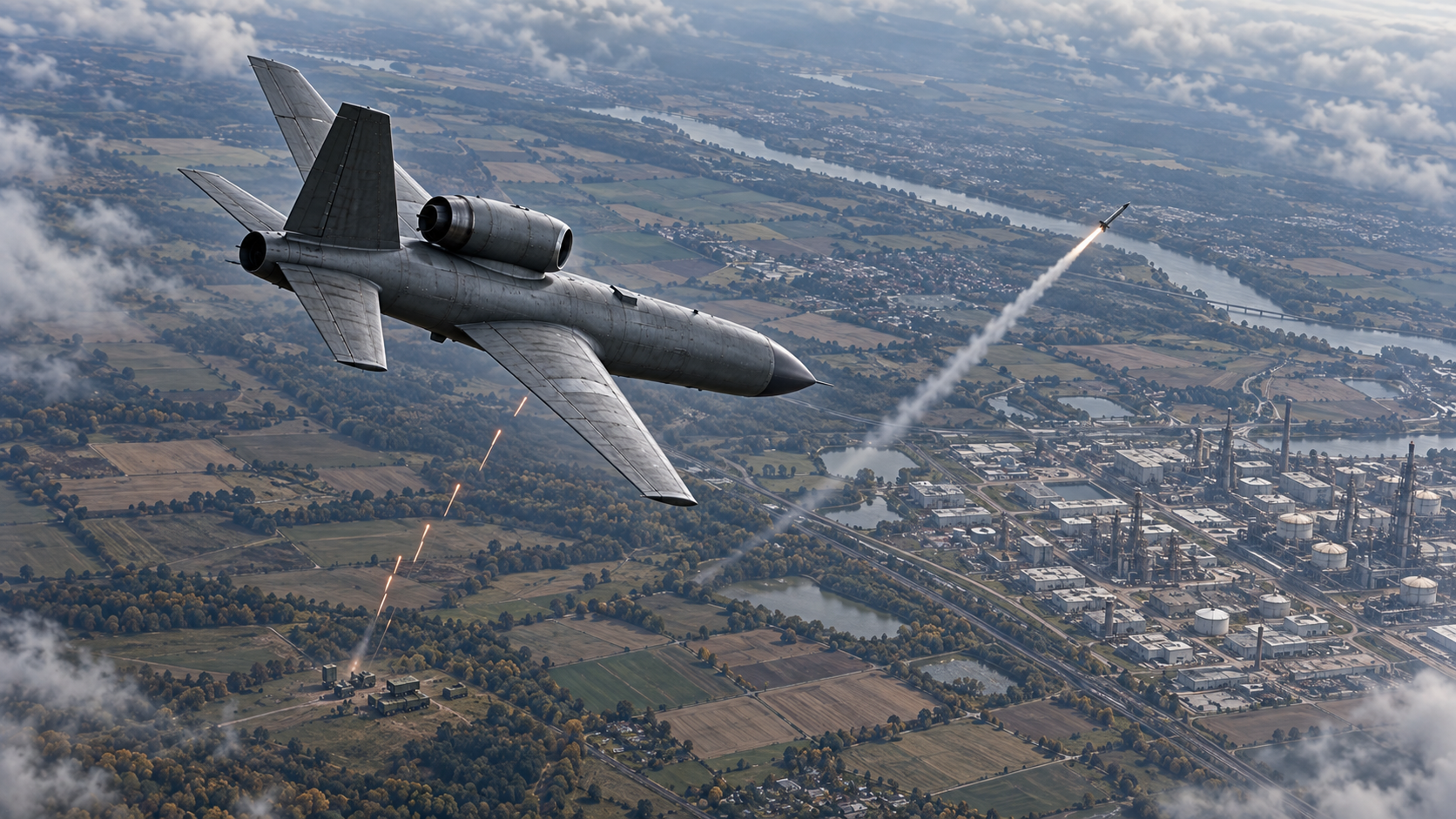
In June 1944, Germany began attacking London with an aircraft that needed no pilot and made no return journey. The V-1 flying bomb carried explosives along a preset course before crashing into its target area. It offered a way to strike a distant city without sending a bomber crew through its defences. More than eighty years later, Russia’s growing use of jet-powered attack drones is presenting Ukraine with a related problem: how to sustain an effective defence against repeated attacks by expendable aircraft. [1, 2]
The historical comparison has limits. The V-1 was an early cruise missile powered by a pulsejet, which produced thrust through repeated combustion pulses. Modern Geran drones use turbine-based turbojets and navigation systems far removed from the V-1’s preset guidance. Germany’s V-2 was a different weapon altogether, a rocket-powered ballistic missile. The connection is the operational logic of an unmanned aircraft carrying explosives on a one-way mission. [1, 2]
Britain countered the V-1 with fighters, anti-aircraft guns supported by radar, ground observers and barrage balloons. These capabilities created successive opportunities to destroy an approaching weapon. The defence depended on organising detection and engagement across several layers, rather than finding a single system that could protect every target. That requirement is becoming increasingly relevant in Ukraine. [2]
Jet-powered unmanned aviation continued developing after the war. The American Q-2 Firebee, first flown in 1951, served as a high-speed target for weapons training. The technology is therefore established. The current change is its integration into expendable attack aircraft manufactured for sustained campaigns, combining faster propulsion with modern guidance and internationally sourced components. [3]
Iran publicly unveiled the Shahed-238 in 2023 as a jet-powered development of its attack-drone family. Evidence of its use against Ukraine appeared in early 2024, followed by Russian manufacture of related aircraft, including the Geran-3. Subsequent Russian models have expanded the category, with different airframes, engines and flight characteristics. The familiar term “jet Shahed” now covers weapons that should not be treated as technically identical. [4]
Ukraine’s military intelligence catalog illustrates the differences. Its assessment of an October 2026 Geran-4 variant lists a cruising speed of 320 kilometres per hour and a maximum of 450 kilometres per hour. The larger Geran-5 is listed with a cruising speed of 450–600 kilometres per hour, a 90-kilogram warhead and a range of 950 kilometres. These are Ukrainian intelligence assessments, but they show how the threat varies across the family. [5, 6]
By late summer 2026, jet-powered drones were appearing in substantial numbers over Kyiv and other Ukrainian cities. They challenged a defence that had become increasingly effective against slower, propeller-driven Shaheds. Ukraine’s mobile gun teams and interceptor drones now faced targets that passed through engagement zones faster, with some existing interceptors unable to catch them. [7, 8]
The practical effect can be expressed in time. An aircraft travelling at 600 kilometres per hour covers ten kilometres in one minute. At 200 kilometres per hour, the same distance takes three minutes. Actual warning depends on detection range, altitude and route, but faster flight reduces the time available to identify a target, assign a weapon and complete an interception. It also leaves fewer opportunities to recover from an unsuccessful engagement.
This changes the economics of the defence. A drone that evades cheaper interception methods can force the defender to use fighter aircraft or more expensive missiles. The attack then creates costs beyond the damage caused by weapons that reach their targets: it consumes ammunition, aircraft availability and maintenance capacity. The strategic concern is whether those demands can be sustained over repeated waves. [8]
Ukraine’s immediate response includes combat aviation. On October 10, President Volodymyr Zelensky announced that Finland would supply ammunition for Ukraine’s F-16s, linking the delivery directly to interceptions of jet-powered Shaheds. The announcement did not specify the ammunition type. Fighters provide the necessary speed and reach, but a prolonged drone campaign creates competition for resources needed elsewhere in the air war. [9]
Automated gun turrets offer a more local response. On October 5, Ukrainian Air Force spokesperson Yurii Ihnat reported successful engagements against jet-powered drones, including Geran-5s, using robotic turrets with machine vision and automated aiming. He also acknowledged their limited engagement radius. These systems can help protect particular sites and approaches, but only when the incoming aircraft passes within reach. Reported interceptions demonstrate a capability; sustained performance against large attacks remains a separate question. [10]
Another response is to develop interceptors specifically for faster aircraft. Quantum Systems and Ukrainian partner WIY have developed SPYS through Quantum WIY Industries. In October, Quantum Systems announced a letter of intent covering tens of thousands of interceptors, with thousands potentially available for delivery during 2026. The announcement describes planned supply, rather than a completed delivery of the full package. [11]
For these interceptors, speed is one requirement among several. Ground sensors must detect the threat early enough to create a viable engagement. The interceptor must launch, accelerate and reach the target with sufficient energy remaining to complete its attack. Its starting position and approach geometry matter alongside maximum speed. An aircraft positioned ahead of a threat faces a different problem from one attempting to catch it from behind.
Guidance is evolving alongside propulsion. Ukrainian intelligence has identified the Susanin electro-optical navigation system in a recent Geran-4 variant. This reinforces a limitation of electronic countermeasures: disrupting satellite navigation cannot be assumed to stop an aircraft that has other means of navigating. Physical interception must remain available when interference fails to defeat the target. [5]
The industrial contest is equally consequential. UNITED24’s investigation, drawing on Ukrainian intelligence findings, describes Chinese Telefly engines in Russian jet drones and a Russian-produced replacement appearing in a newer Geran-4. The ability to obtain or manufacture small turbojets helps determine whether an improved design remains a limited capability or becomes a recurring threat at scale. Ukraine faces the corresponding challenge of producing and replenishing suitable interceptors and ammunition. [12]
The V-1 comparison is useful because it connects the weapon to the defensive system it forces an adversary to build. Today, improved guidance and rapidly changing designs make the problem more complex, but the central requirement remains recognisable. Ukraine needs a combination of detection, electronic warfare, guns, aircraft and interceptors that can defeat fast targets repeatedly at a sustainable cost.
The future significance of jet-powered drones will depend on that balance. Faster expendable aircraft can extend the pressure on cities and infrastructure while consuming defensive resources. Whether they provide a lasting military advantage will depend on how quickly defenders adapt, and whether their industries can sustain that adaptation after the first successful interception.
Explore stories by subject ↗