
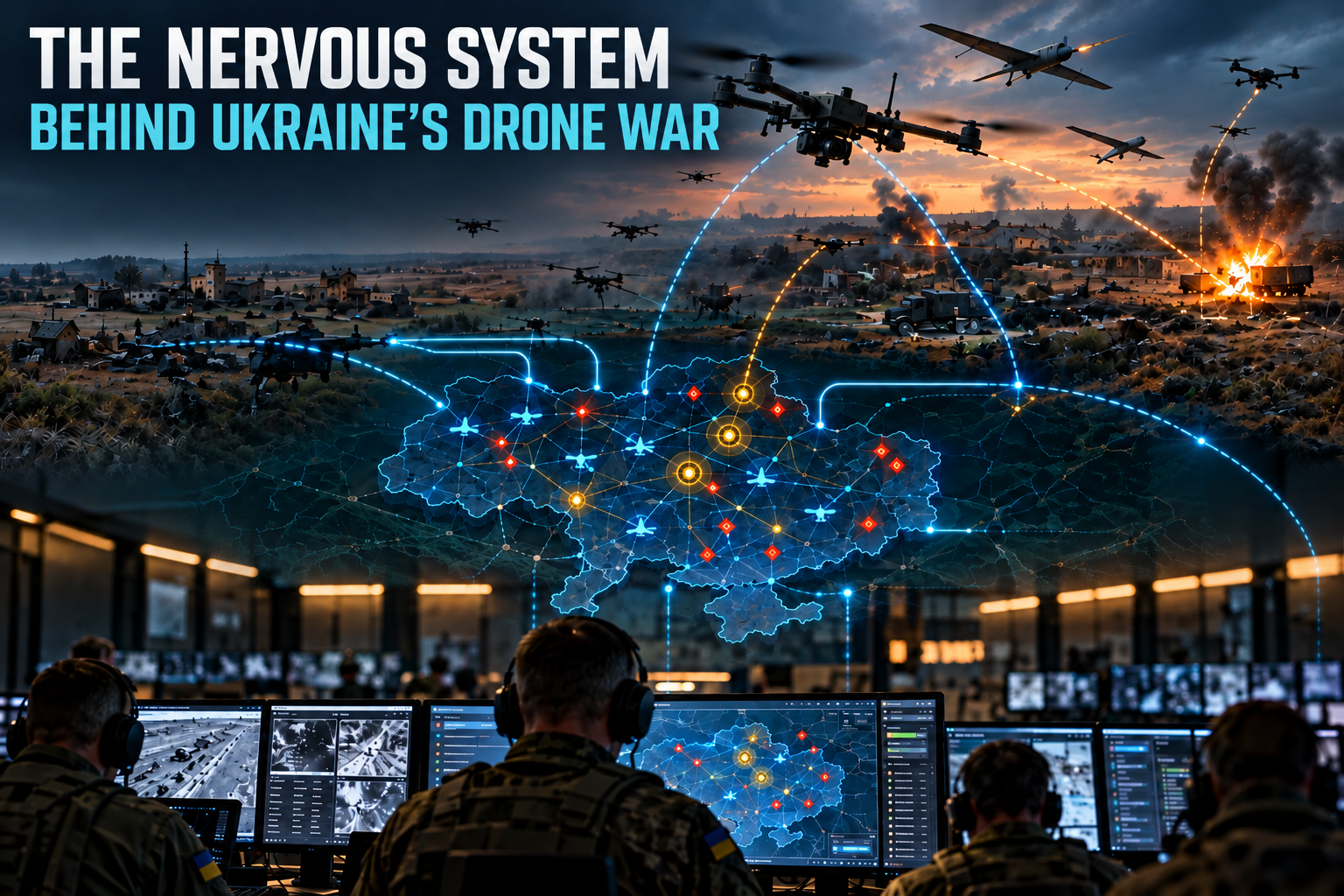
Ukraine’s drone war is often described in terms of hardware: FPV drones, long-range strike aircraft, unmanned ground vehicles, and maritime systems. Yet the more consequential transformation may be taking place behind the operators’ screens.
As unmanned systems proliferate across the battlefield, the central challenge is no longer simply deploying more drones. It is coordinating their activities, assigning missions, managing overlapping operational areas, processing enormous volumes of intelligence, and ensuring that the right weapon reaches the right target at the right time.
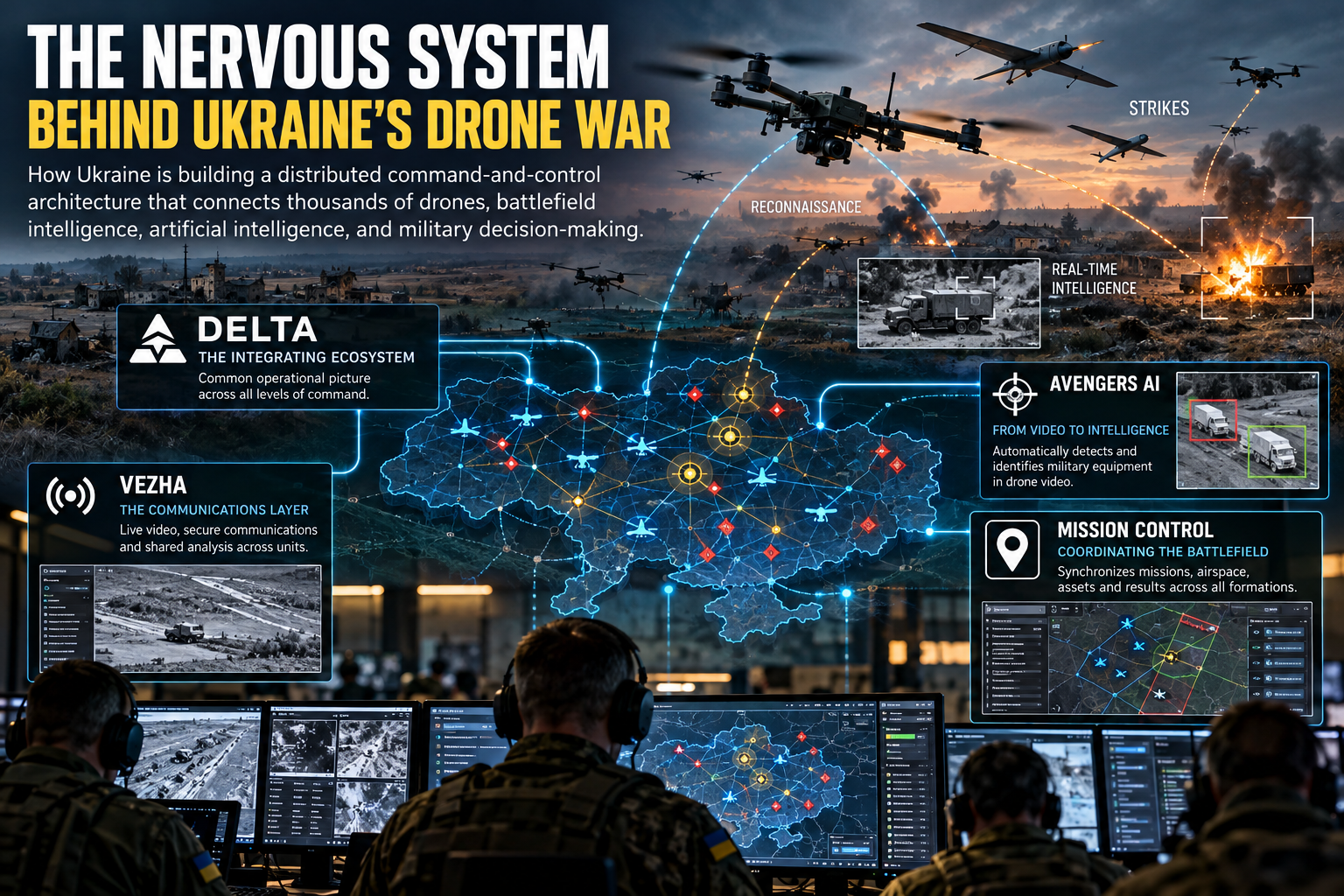
Ukraine’s response is an increasingly integrated digital command-and-control architecture, built around the DELTA battlefield management ecosystem.
Rather than establishing a single centralized command center that directly controls every drone, Ukraine is developing a distributed network that connects national headquarters, operational formations, tactical commanders, and individual drone crews through a shared information environment.
From individual drone crews to a coordinated force
In the early stages of the war, Ukrainian drone operations were frequently organized at the unit level. Individual formations developed their own reconnaissance networks, communication channels, target databases, and methods for coordinating strikes.
This decentralized innovation accelerated the introduction of new technologies, but it also created operational difficulties.
Multiple drone units could operate in overlapping sectors without full awareness of each other’s activities. Electronic warfare systems could interfere with friendly drones. Intelligence gathered by one unit might not reach another formation capable of engaging the target.
The problem became more complex as Ukraine began operating thousands of unmanned systems across the front.
The DELTA ecosystem was designed to address these challenges by providing a common operational picture and connecting reconnaissance, planning, coordination, and engagement processes.
Its architecture includes several complementary systems, each addressing a different part of the operational cycle.
Three levels of command and control
At the national level, DELTA provides senior commanders and defense authorities with an aggregated picture of battlefield activity. Information from sensors, reconnaissance platforms, and operational units can be consolidated to support planning, resource allocation, and assessments of operational effectiveness.
At the regional and operational level, commanders use shared information to coordinate activities across formations, manage operational sectors, and synchronize reconnaissance and strike missions.
At the tactical level, drone crews and frontline commanders contribute observations, mission information, and engagement results while receiving the information necessary to coordinate their activities with neighboring units.
These are functional levels of a distributed command architecture, rather than three entirely separate drone-control networks.
The introduction of Mission Control has strengthened the connections between them.
In January 2026, Ukraine formally launched an expanded Mission Control capability within DELTA. Drone crews record information including aircraft type, launch location, flight route, and assigned mission.
The objective is to replace fragmented reporting with structured operational data that can support faster decisions.
Mission Control: Coordinating the drone battlefield
Mission Control addresses one of the fundamental problems of operating large numbers of unmanned aircraft within a relatively confined battlespace.
Drone operations require coordination of flight zones, mission schedules, radio frequencies, and reconnaissance and strike activities.
Without coordination, different units can compete for the same airspace or inadvertently disrupt each other’s communications.
Mission Control provides a mechanism for synchronizing these activities and improving commanders’ visibility into available assets and ongoing operations.
The system also creates an increasingly valuable record of operational performance, allowing commanders to assess which platforms, crews, and mission types are delivering results.
This information can inform future assignments, operational planning, and equipment procurement.
However, the existence of a shared digital system should not be confused with automated nationwide control of drone missions. Individual crews and commanders remain essential to planning and execution.
Vezha and the communications layer
Command and control depends on the ability to distribute intelligence quickly enough for it to remain operationally useful.
Vezha, integrated into DELTA, provides a battlefield video environment that allows drone crews, intelligence analysts, artillery units, and command posts to access and jointly analyze reconnaissance feeds.
Its capabilities include live video streaming, voice communication, and collaborative examination of imagery.
This creates a connection between the sensor observing a potential target and the units responsible for assessing or engaging it.
The wider DELTA ecosystem also incorporates communications and information-sharing tools such as Element, which supports secure messaging between dispersed military formations.
These services form part of the information infrastructure connecting reconnaissance, command, and strike elements.
They do not eliminate the underlying vulnerability of drone operations to electronic warfare, communications disruption, or the loss of data links.
Avengers AI: From video to actionable intelligence
One of the greatest challenges facing Ukrainian commanders is the volume of information produced by unmanned reconnaissance systems.
Thousands of video feeds, images, and observations must be processed to identify military equipment, detect changes in enemy positions, and establish which targets deserve attention.
The Avengers AI platform addresses part of this problem through automated object detection and recognition.
Integrated with DELTA and Vezha, Avengers can help identify vehicles and military equipment in reconnaissance imagery, reducing the burden on human analysts.
This capability potentially accelerates the process of converting raw surveillance footage into actionable intelligence.
It also provides a foundation for more sophisticated decision-support systems, including tools that could assist commanders in prioritizing targets and matching available weapons to operational requirements.
Yet an important distinction remains: publicly documented AI-supported detection does not establish that Ukraine has deployed a fully automated national system that independently selects targets, assigns weapons, and authorizes attacks.
The publicly described architecture still depends on human command decisions.
Closing the loop: From battlefield results to future operations
Ukraine’s digital command architecture increasingly connects another essential function: evaluating the results of drone operations.
Mission reports and engagement outcomes provide information about the effectiveness of different platforms, tactics, and formations.
The ePoints incentive and reporting mechanisms add another dimension by linking verified operational results with performance measurement and procurement priorities.
In principle, this creates a feedback loop in which battlefield experience influences equipment acquisition, tactical development, and the allocation of resources.
The importance of this process extends beyond administrative efficiency.
As unmanned systems become consumable military assets deployed in enormous quantities, commanders must continuously determine which systems are effective, where they are needed, and how limited resources should be distributed.
The future of drone warfare is a network
Ukraine’s experience suggests that the decisive advantage in unmanned warfare may not belong to the military operating the largest number of drones.
It may belong to the force capable of integrating those drones into the most effective reconnaissance, command, communications, and engagement network.
DELTA, Mission Control, Vezha, and Avengers represent different components of this emerging architecture.
Together, they illustrate a transition from relatively independent unmanned platforms toward a coordinated, data-driven system of military operations.
The next technological challenge is to connect these systems more closely, using AI not only to identify objects but also to support operational planning, prioritize competing demands, and improve the allocation of unmanned assets.
That evolution introduces its own risks. Incorrect target recognition, unreliable data, communications failures, and poorly understood algorithmic recommendations can propagate through an integrated command network.
The central challenge is therefore not simply making battlefield decisions faster, but ensuring that increased speed does not come at the expense of verification, accountability, and command authority.
Ukraine is demonstrating that the future of unmanned warfare will be determined as much by the systems connecting drones as by the drones themselves.
Explore stories by subject ↗