
Ukraine’s amphibious supply robot illustrates a broader transformation: unmanned systems are becoming part of the logistics infrastructure that allows troops to remain in combat.
On September 29, Ukraine’s Ministry of Defence announced that a domestically developed amphibious ground robot had completed its first logistics mission. The vehicle travelled more than 40 kilometres across land and water, delivering provisions and ammunition to military positions. Developed with input from frontline personnel and grant support from the Brave1 defence innovation cluster, it could transition from land to water within seconds.
The immediate achievement was crossing terrain that can obstruct conventional supply vehicles. Rivers, canals and marshes can force units to change routes, transfer cargo between platforms or depend on aerial delivery. An amphibious unmanned ground vehicle, or UGV, offers another option: carrying supplies along a mixed route without putting a driver aboard.
The larger development is the growing role of robots in sustaining combat operations. Delivering ammunition, water, food and equipment is a recurring requirement. When supply movements expose personnel to attack, the ability to perform them remotely can affect how long a position remains viable and how many soldiers are needed to maintain it.
Ukraine’s operational figures show how rapidly this role is expanding. According to its defence ministry, the DELTA combat system recorded approximately 112,000 UGV logistics and evacuation missions between January and early September 2026. Monthly activity rose from 7,511 missions in January to 25,143 in August. These figures combine logistics and evacuation, rather than counting supply deliveries alone, but indicate sustained use across the force.
Procurement reflects that priority. By July, Ukraine’s Defence Procurement Agency had contracted more than 22,000 domestically manufactured ground robots for 2026. The overwhelming majority were logistics systems, ahead of engineering and combat platforms. Contracts do not equal completed deliveries, although the ministry said thousands of vehicles had already reached units.
Different platforms for different loads
Robotic logistics is developing around a range of vehicles rather than one standard design. At the smaller end, Ukraine’s Spider weighs slightly more than 50 kilograms and can carry up to 100 kilograms, according to the defence ministry. Two vehicles can fit into the cargo area of a military pickup, allowing a unit to transport them to its operating area before sending them forward with supplies.
Larger tracked platforms can move heavier loads and accommodate different mission modules. In its authorization announcement for TERMIT, the ministry described a payload capacity of up to 300 kilograms, several hours of battery operation and the ability to travel several dozen kilometres. It identified logistics, casualty evacuation, mine-laying and equipment transport configurations, and said earlier versions were already operating at the front. Those specifications apply to the version covered by the announcement; subsequent models and configurations differ.
The heavier PROTECTOR moves closer to the role of an unmanned utility vehicle. Authorized in June 2025, it has a stated payload of up to 700 kilograms, an internal combustion engine, all-wheel drive and run-flat tyres. Its intended tasks include ammunition and equipment delivery and casualty evacuation. The ministry lists a range of up to 400 kilometres, although that specification is not evidence of a completed combat delivery over that distance.
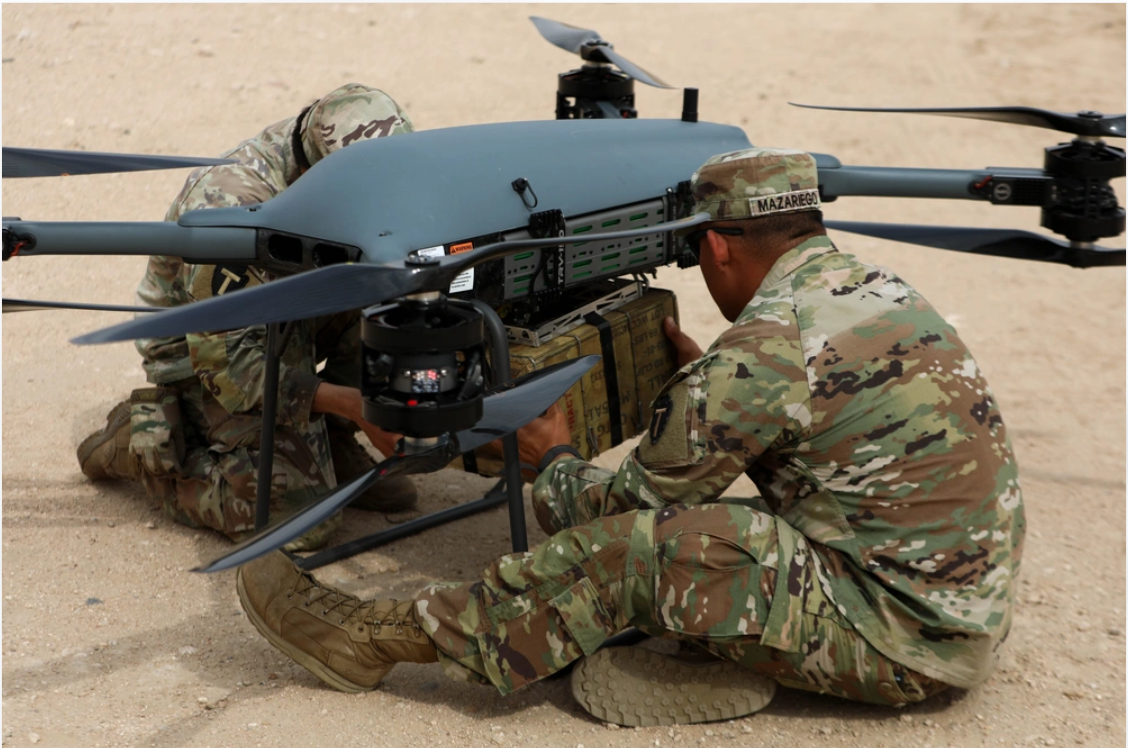
Aerial drones provide a complementary capability. Ukraine’s Vampire, a six-rotor aircraft primarily associated with bombing missions, also carries supplies. The Ukrainian defence ministry describes a payload of up to 15 kilograms and a range of 20 kilometres. Soldiers interviewed by Reuters in May 2026 said Vampire drones were delivering food, water and medical supplies into dangerous frontline areas to reduce human exposure.
These systems address different parts of the same problem. An aircraft can bypass surface obstacles and deliver a small, urgent package. A ground robot can carry substantially more cargo where a usable route exists. An amphibious vehicle extends that route across water. The operational choice depends on the load, terrain, threat and available communications.
Supply delivery and casualty evacuation
Many ground platforms combine logistics and evacuation functions. Estonia’s Milrem Robotics delivered a THeMIS UGV to Ukraine in September 2022, configured for supply transport and casualty evacuation, with stretchers fitted to the vehicle. Ukrainian systems such as TERMIT also offer evacuation variants.
The connection is practical: both missions require moving a load through dangerous terrain. Transporting a wounded person, however, adds demands for stability, protection and medical support. A robot does not remove the need to assess, treat and load the casualty. Its potential contribution is reducing the number of people exposed during the journey.
A platform capable of supporting both functions gives commanders more flexibility. It can help sustain a position and provide a means of moving casualties away from it, although the feasibility of either task depends on the route and battlefield conditions.
Unmanned resupply itself has an earlier combat precedent. Beginning in December 2011, the US Marine Corps operated unmanned K-MAX cargo helicopters in Afghanistan. A later Marine Corps account credited the two aircraft with moving almost five million pounds of cargo over nearly three years and keeping numerous supply convoys off roads exposed to roadside attacks.
Ukraine’s experience extends that principle to smaller platforms operating closer to individual positions, with ground robots performing tasks that previously required personnel or conventional vehicles.
The challenge extends beyond the vehicle
Carrying capacity and mobility are only part of an effective robotic logistics system. Ground robots must negotiate obstacles while maintaining communications with their operators. Terrain and buildings can obstruct radio links, while electronic warfare can disrupt control.
The SIRKO-S1 illustrates the distinction between a vehicle’s ability to travel and an operator’s ability to control it. Ukraine’s defence ministry describes communications over up to three kilometres in line-of-sight conditions, potentially extended to ten kilometres using a repeater. Milrem has separately introduced a Starlink-equipped THeMIS intended to support control over greater distances. These approaches expand connectivity options without guaranteeing reliable operation in every environment.
Unmanned should also be distinguished from autonomous. Several platforms are explicitly described as remotely operated. Their immediate value comes from removing the driver from the vehicle, while retaining a human operator responsible for its movement.
That creates requirements for training and organization. In announcing robotic units within combat brigades, Ukraine’s defence ministry emphasized that operators must learn to plan routes, establish communications and coordinate with other units. Driving the platform is one part of the job. Keeping it maintained, preparing cargo and arranging delivery or evacuation are also necessary to turn a vehicle into a dependable capability.
The amphibious mission therefore matters beyond its demonstration of a robot crossing water. It adds another route that unmanned transport may be able to serve. Combined with Ukraine’s growing mission totals and procurement, it suggests that robotic logistics is becoming an established military function.
The relevant measure is whether these systems can repeatedly deliver what troops need, when they need it, while reducing exposure along the way. Their contribution to warfare will be determined as much by reliable supply missions as by the more visible use of robots to find and attack targets.
Explore stories by subject ↗