The underwater battlespace presents navies with a difficult equation. Submarines are among their most valuable assets, but they are also expensive, scarce and crewed by highly trained personnel. At the same time, the missions assigned to them are expanding. Navies must monitor hostile submarines, inspect seabed infrastructure, map minefields, collect intelligence and maintain a presence across areas too large for conventional fleets to cover continuously.
Uncrewed underwater vehicles, generally described as UUVs or autonomous underwater vehicles, offer a way to distribute some of those missions across larger numbers of less expensive platforms. Their purpose is not necessarily to replace crewed submarines. It is to send machines ahead of them, extend their reach and accept risks that commanders may be unwilling to impose on a crew.
An Operational Technology, but Not Yet an Underwater Drone Fleet
The most mature military UUV applications are relatively narrow. Small and medium vehicles are already used for hydrographic surveying, environmental sensing and mine countermeasures.
The US Navy operates the Mk 18 Mod 2 Kingfish, a torpedo-shaped vehicle that searches the seabed for mine-like objects while keeping divers and ships outside the suspected minefield. Its Naval Oceanography force has also operated more than 130 Littoral Battlespace Sensing gliders, slow and persistent vehicles that collect information about temperature, salinity and other conditions affecting sonar performance.
Europe is moving toward complete robotic mine-clearance chains. The Belgian-Dutch rMCM programme combines command ships with unmanned surface craft, A-18 underwater search vehicles, identification systems and expendable mine-neutralisation robots. The second ship, Vlissingen, was delivered to the Royal Netherlands Navy in February 2026. This model allows the crewed ship to remain outside the danger zone while robotic systems detect, classify and destroy mines.
Larger systems are extending the mission set. Israel Aerospace Industries’ BlueWhale is designed for intelligence collection, mine detection and anti-submarine warfare, using flank sonar, a towed acoustic array and a telescopic mast carrying radar, electro-optical sensors and satellite communications. IAI says the vehicle can remain deployed for two to three weeks and has completed thousands of hours of autonomous operation. Germany has conducted operational trials of the system, although public information does not establish the full extent of its current operational deployment.
The Difficult Leap to Extra-Large Vehicles
Extra-large UUVs, or XLUUVs, promise much more payload capacity and endurance, but most programmes remain in testing or early fielding.
The US Navy’s Boeing-built Orca uses a removable 10.4-metre payload section capable of carrying sensors or smaller vehicles. The first test asset was delivered in 2023, but the programme experienced approximately five years of delays, including problems sourcing materials and manufacturing pressure-resistant components.
Britain’s 12-metre XV Excalibur, developed under Project Cetus, is explicitly an experimental platform rather than an operational combat vessel. It is being used to study how large autonomous submarines can work with crewed platforms, carry mission-specific payloads and operate within allied command structures. In 2025, British operators demonstrated control of Excalibur from Australia, more than 10,000 miles away, as part of AUKUS experimentation.
These examples show the gap between possessing a large robotic submarine and fielding one as a dependable weapon. Australia is now attempting to close that gap.
Ghost Shark Gets Teeth
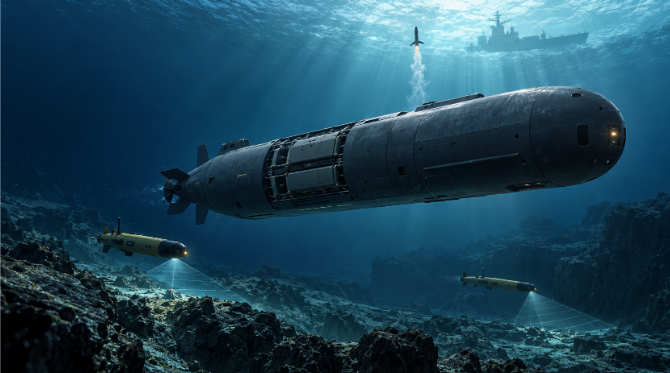
On 19 October 2026, Australia revealed three previously classified payloads for the Anduril-developed Ghost Shark: a module carrying up to 12 naval mines, concealed logistics caches and tube-launched ALTIUS aircraft for surveillance or strike missions.
Australian Defence Industry Minister Pat Conroy said the vehicle would be able to release swarms of ALTIUS loitering munitions. Anduril added that its modular bays could eventually accommodate lightweight and heavyweight torpedoes and claimed the vehicle would be capable of engaging threats independently. The mine and aerial-strike payloads are government-confirmed capabilities; the torpedo configuration and independent engagement claim came from the manufacturer and should be treated separately.
Ghost Shark is also further along industrially than many comparable programmes. Australia signed a A$1.7 billion production agreement for dozens of vehicles, with the first system delivered to the navy for testing and acceptance three months later. Yet “initial operating capacity,” payload integration and proven combat effectiveness are not the same thing. Publicly available evidence does not yet show a complete operational strike trial involving mine deployment, an ALTIUS swarm or torpedo engagement.
The important change is conceptual. Ghost Shark is not merely an underwater reconnaissance platform. It is being developed as a mobile payload carrier that can place mines, hide supplies on the seabed, release aerial weapons and potentially attack underwater targets. A robotic submarine can therefore affect the seabed, the water column, the surface and the airspace above it.
Why Underwater Autonomy Remains Difficult
Underwater vehicles cannot depend on the communications architecture used by aerial drones. Radio signals and GPS do not function normally below the surface. Acoustic communications are slower, offer limited bandwidth and may expose the vehicle’s presence. This means that a UUV must navigate, avoid obstacles, manage energy and respond to unexpected conditions with limited human intervention.
Power is another constraint. A larger battery permits a longer mission but adds weight and volume. Speed consumes energy rapidly, while payloads, processors and active sensors compete for the same limited supply. Corrosion, biofouling, water pressure and the difficulty of recovering a disabled vehicle compound the engineering problem. DARPA and the US Office of Naval Research continue to fund work on energy harvesting, underwater communications, reliable autonomy and long-duration operation precisely because these challenges remain unresolved.
Autonomous weapons introduce a further problem: a vehicle may spend days beyond reliable communication before encountering a possible target. The more independent it becomes, the harder it is to ensure that its information remains current and its actions remain consistent with the commander’s intent and the laws of armed conflict.
The future underwater force will therefore not consist simply of crewless replacements for today’s submarines. It will include expendable mine-neutralisation robots, persistent gliders, reconnaissance vehicles, seabed sensors and large modular platforms operating alongside crewed ships and submarines. Ghost Shark matters because it connects these established functions with offensive payloads. The silent fleet is beginning to acquire weapons.
Explore stories by subject ↗